
This report from the Eliot School of International Affairs, Washington DC on

In 2021, the Moroccan parliament approved Law 13–21, which legalized the cultivation of cannabis for medical, pharmaceutical, and industrial purposes while maintaining its prohibition on recreational cannabis use in the country.
The law went into effect in July 2021. In 2022, Morocco established the Agence Nationale de Réglementation des Activités Relatives au Cannabis (ANRAC or the National Agency for the Regulation of Cannabis-related Activities). And, in August 2024, Morocco’s King Mohammed VI pardoned over 4,800 people in cases related to illegal cannabis cultivation. Without directly referencing the Hirak al-Rif Movement, a large protest movement in the Rif region that began in October 2016, the regime responded to one of its demands by pardoning farmers facing charges for illegal cannabis cultivation.
Those moves stand out in a region where the penalties associated with possession, use, and sale of any drugs are harsh. Saudi Arabia publicly reported over 300 executions in 2025, of which it is estimated that two-thirds were for drug-related offenses.
In nearby Tunisia, efforts to move away from the harsh drug enforcement tactics of the repressive Ben Ali regime have largely stalled. In 2017, after the uprising and political opening in Tunisia, the government introduced reforms to Law 52 to reduce prison sentences which had required mandatory prison sentences for any drug possession; however, the recent power grab by President Kais Saied has also ushered in a return to the harsh policing and sentencing of drug possession.
Morocco’s Law 13-21 ‘does not go far enough’
Morocco, in contrast to these regional trends, moved ahead with the legalization of cannabis for limited purposes.
Critics of Law 13-21 argue that it does not go far enough. They argue that it maintains the penalization of cannabis possession and cultivation for recreational purposes.
More importantly, for those in the Rif region, which is the primary region for cannabis cultivation in Morocco, the reforms do little to impose new limits on the coercive power of the Moroccan state, which has been particularly repressive in the Rif region, often using illicit cannabis cultivation as a pretext for broad and harsh crackdowns on the region’s residents. And the pardon only extends to a portion of those facing charges related to cannabis cultivation.
Why did the Moroccan state enact these limited reforms? How does cannabis reform fit within the broader context of demands made by mobilized political movements, and does the recent law meet their demands?
Morocco’s Own Mpondoland: Rif Valleycannabis industry and the Rif region
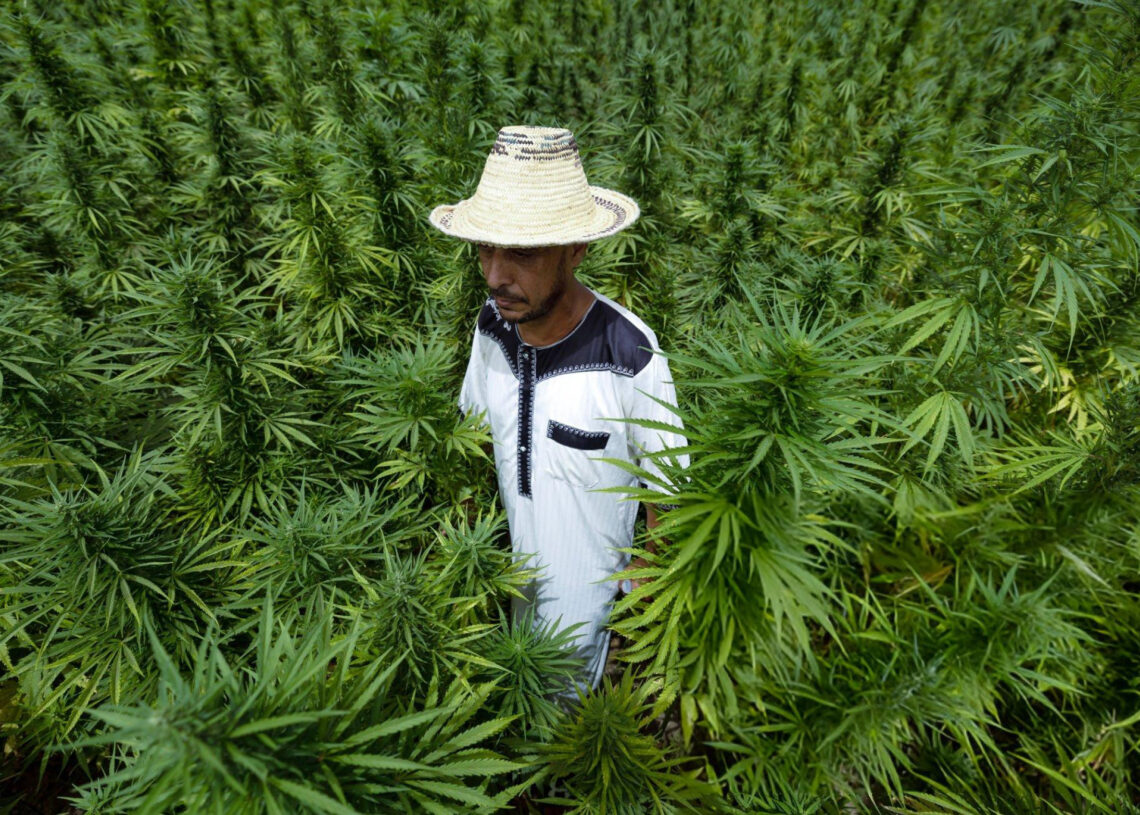
Over the last several decades, the political demands for reform of Morocco’s drug laws have emanated most loudly from the Rif region of Morocco (an area located in and around the Rif mountains in the north of the country. The Rif region (‘the Rif’) is the primary centre for cannabis cultivation in Morocco, which overall is the largest producer of cannabis for the European market.
In the Rif region, cannabis farming constitutes an important part of the Rifian economic, social, and political life. Cannabis cultivation has a long history in the region, and, while estimates vary, it is estimated that 700,000 to 1 million people depend on cannabis production for their livelihood.
Its impact on the economy is multifold; while the farmers’ profits are limited, many benefit from the significant corruption that surrounds the industries, for instance, in the form of bribes. And the industry has significant economic potential, as legalization has demonstrated elsewhere.
While the military and police repression in the Rif extends beyond enforcement of drug laws, the country’s historic drug policies have long been a pretext for harsh state violence against Rif inhabitants.
In 2018, it was reported that one-quarter of all incarcerated people in Morocco were serving a drug-related sentence and over 60 percent of those in pre-trial detention were held for a drug-related offense.
Farmers who are reported for illicit cannabis cultivation often have their crops burned and property destroyed.
In a recent interview in New Lines Magazine, one Rif resident recounted a childhood “punctuated by dramatic raids by government forces who would descend on his family’s small holdings in the mountains and burn their crops, destroying a year’s worth of income in a few hours. He said he can still see his father’s helplessness, still hear his mother’s screams and his sisters’ cries.
The social effects of this repression also touch those not in the cannabis industry. The Rif region’s link to the illicit drug industry has led to the collective social stigmatization of all with ties to that region. The Rif’s marginalization and stigmatization, therefore, is also the result of the Moroccan state’s collective punishment of the Rif for perceived opposition to the regime.
The political movement for reform
The state’s violent history of engagement with the Rif region over cannabis cultivation is intertwined with the Rif’s long history of political mobilization against the central state, including against Spanish and French colonial governments and the post-colonial Moroccan governments.
The deep and long-standing tension between the Moroccan state and the Rif region is reflected in many issues and interactions. These tensions recall the country’s early division between ‘bilad al-makhzen’ (government land) and ‘bilad al-siba’ (land of dissidence). The Rif, specifically, has been termed “an area of challenged state authority as a result of persistent Rifian opposition to the Moroccan regime.
Abd el-Krim al-Khattabi, a Rifian political activist and leader who led a revolt against Spanish colonial rule in the 1920s, is often referenced in coverage of contemporary political mobilization in the Rif to demonstrate the long-standing regional grievances and activism of the Rif region. Similarly, the 1958 Intifada al-Rif (‘Rif Revolt’) and the repression of demonstrations against austerity measures in 1984 loom large in the collective memory both within and outside of the Rif.
Calls for reform have come both from political elites and from popular movements. At the elite level, politicians close to the Moroccan monarch have pushed for reforms over the last two decades. In 2009, Fouad Ali El Himma, a close advisor to King Mohammed VI and a founder of the Party of Authenticity and Modernity (PAM), called for a national dialogue on cannabis legalization.
In 2014, PAM released a draft law proposal to legalize marijuana cultivation for medicinal purposes, and PAM politicians like Mehdi Bensaid and Ilyas El-Omari publicly advocated for the legal changes.
The draft law was also supported by another important Moroccan political party, the Istiqlal Party. Nouredin Moudian, a member of Istiqlal who represented the Rif region’s El Hoceima in the Moroccan parliament, was also an early supporter of a government dialogue on cannabis production, calling cannabis cultivation a “reality, whether we like it or not.” He criticized the regime for its repression of cannabis farmers and for not providing Rif residents with alternative economic opportunities.
Rif Valley has always been a centre of popular resistance
At the popular level, the Rif region was the center for a major and enduring protest movement, Hirak al-Rif (the ‘Rif Movement’), which was ignited in October 2016 when a fishmonger, Mouhcine Fikri, was crushed in a garbage truck compactor after jumping into the truck because local security officials confiscated his fish.
While the Rif region has been mobilized during national protest waves like the February 20 Movement in 2011 and the GenZ212 Movement in 2025, the more localized Hirak protest wave proved highly durable within the Rif region.
While the Hirak al-Rif activists had a long list of demands, including increased economic and educational investment in the region, key demands reflected a shared desire for reforms to the Moroccan state’s cannabis policy and its use of coercive power in the region. This included calls for “revocation of the 1958 decree that declared Al Hoceima a military zone; […] dropping all the legal charges against cannabis growers; […] and appointing competent civil servants committed to human rights.”
All of those reforms speak to the Rif region’s long exposure to the coercive power of the Moroccan state, which was in part exacerbated by anti-drug laws that created a pretext for periodic harsh crack-downs.
The political movement for reform is also bolstered by the cannabis farmers themselves who constitute an example of what Bayat has termed a ‘social non-movement.’[23] Many of these farmers have persisted in their cultivation of cannabis over decades despite facing state repression.
This collection of uncoordinated acts of individuals and families have constituted—over several decades—a quotidian, but powerful challenge to the Moroccan state and its policies. Some of this popular frustration with the Moroccan state is reflected in recent public opinion data. In a 2023 national survey, government satisfaction among respondents in the Rif is lower than for those outside the region.
Moroccan government reforms do not resolve the Kingdom’s cannabis issues
In 2021, Morocco legalized the cultivation of cannabis for medical, pharmaceutical, and industrial purposes, although the government maintained its prohibition on recreational cannabis use. Does this reform mark the start of a new approach to managing the cannabis industry in the country? And does this reform meet the demands of the various actors described above?
The legalization of cannabis cultivation for medicinal or industrial purposes is in line with the types of reforms that some of the Moroccan political elite were calling for over a decade ago. Law 13-21 paved the way for the creation of the Agence Nationale de Réglementation des Activités Relatives au Cannabis (ANRAC), which licenses cannabis farmers that seek authorization from the state.
This formalizes at least part of the cannabis economy, reducing licensed cannabis farmers exposure to the coercive apparatus of the Moroccan state.
It is less clear how the law is being received at the popular level. Since the legalization of cannabis cultivation for medicinal or industrial purposes became law in 2021, there is some evidence that the state’s relationship with the Rif region has improved. In one interview, a long-time cannabis farmer stated that “legalization is freedom,” particularly, freedom from police harassment.
Another farmer noted the effect legalization has had on fear and stigmatization, saying “Now, I can say without fear that I am a cannabis farmer.” And these views are not unique. ANRAC reported that around 5,000 farmers were licensed in 2025 compared to just over 400 in 2023.
However, some argue that the Moroccan regime’s reforms do not go far enough. Notably, Law 13-21 did not fully decriminalize cannabis or legalize recreational use or provide large-scale remedies for those who suffered at the hands of the state’s coercive apparatus for activities now legalized.
Critics argue that the law serves the interests of large companies interested in capitalizing on a profitable industry, rather than serving the interests of the cannabis farmers and the broader Rifian communities that have faced state violence and limited access to economic opportunities.
Reforms have bought with them a new form of prohibition
Indeed, some reporting suggests that the state has engaged in tougher drug enforcement against illicit cannabis cultivation in the years after legalization. Other critics note that ANRAC’s licensing process has been slow and onerous on the farmers, with the agency requiring permits for every stage of the supply chain. Once licensed, cannabis farmers are required to join a specified cooperative, and these cooperatives have reportedly been slow with payments to farmers.
All of these factors have contributed to popular scepticism of the reforms and have likely limited or slowed the uptake of ANRAC’s licensing program. In 2025, licensed cannabis cultivation covered nearly 6,000 hectares of land, while illicit cannabis farming covered close to 28,000 hectares.
Beyond licensing challenges, the recreational cannabis market remains robust, and some farmers believe the profits are higher as well, justifying the risks of state harassment and violence. Some have called for further reforms that centre cannabis farmers social and economic needs through further decriminalization of cannabis cultivation for recreational purposes. Until then, the Rifian farmers’ social non-movement is likely to persist.
The frustration with state policy and distrust of the regime impedes the implementation of the new law and opens some in the community up to renewed state repression for their unlicensed farms, creating a vicious cycle.
Anthropologist Khalid Mouna observed that the farmers in the Rif “flee from everything that represents the state because of the repression and abandonment of which they have long been victims,” including the new framework for legal cannabis cultivation. In this enduring context of distrust, Law 13-21 alone is unlikely to resolve the long-stablished tensions between the Moroccan state and the Rif.
#





