
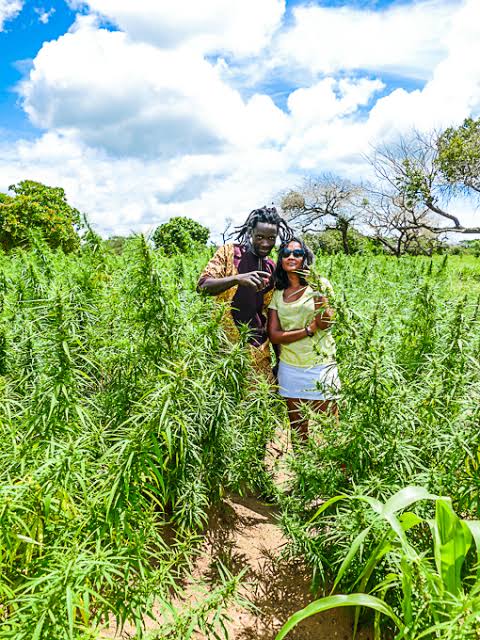
Image of cannabis fields in Jinack, courtesy Me With My Suitcase

It is illegal to cultivate, use or possess cannabis in The Gambia but villagers of Jinack Island continue to grow the plant as they have done for many years because the cops have their hands tied and cannot enforce the law there.
This is not because of any legislative loophole, but because of the ‘ancestral curse’ of Jinack, which has given the island a ‘Treasure Island’ reputation that has spread throughout West Africa.
The ancestral curse is said to befall any authority figure trying to interfere in the affairs of the inhabitants of the tiny fishing island. The fact that it is almost impossible to grow traditional cash crops such as rice and groundnuts in the cluster of villages on the 10 km long island in the North Bank Region, has seen farmers increasingly turn to cannabis farming as a means of livelihood.
Mainland authorities attempted to stop the illicit grows, but were met with fierce resistance by Jinack islanders, invoking the spirits of their ancestors. After a series of inconclusive clashes, law enforcement appeared to have decided to make a tactical withdrawal from the island. This has made Jinack a ‘Grey Zone’ jurisdiction where the anti-cannabis law is optional, unlike in other parts of The Gambia where it is rigorously enforced. This has led to a lively illicit cannabis economy on the island which has evolved into a transit point for serious narcotics trafficking.
However, it’s not just the cannabis growers and drug smugglers that enjoy this ‘ancestral indemnity’, Jinack has come into the news lately as a major migrant transit hub. In the last year, the island has been taken over by human traffickers, taking advantage of the reluctance of law enforcement officials who don’t want to run the risk of personal misfortune befalling them.
Jinack’s reputation as a hotbed of illicit activity, has earned it the nickname of ‘Paradise’, which gives a certain spin to the concept of ‘church planting’ which has created a fresh controversy. Ninety nine percent of Jinack’s population of 2 000 people is Muslim, but in a break with longstanding religious custom, Nigerian Pastor Babatunde Adeniyi (47) and his family arrived a few years ago to plant the seed of Christianity – and to try and persuade islanders to look at possible means of income other than cannabis and drug trafficking.
Chances of the pastor succeeding are on the lower end of the spectrum.
The Gambia is a key illicit substances transit and consumption hub in West Africa, known for the shipment of narcotics including cocaine, heroin and cannabis, destined for Europe and other regions.
Cannabis remains the most commonly consumed and seized drug, linked with cross-border syndicates. As a consequence, the country’s anti-narcotics unit, The Drug Law Enforcement Agency The Gambia (DLEAG) has its hands full, leading domestic crackdown with support from international partners.
The country’s former leaders and institutions have also been implicated in drug trafficking. As recently as last month, the country’s First Lady Fatoumata Bah Barrow, wife of President Adamu Barrow, and Interior Minister Abdoulie Sanyang were accused of involvement.
Cannabis cultivation, possession, use and trade are outlawed in terms of The Drug Control Act. Latest published drug seizures statistics date back to as far as 2023 when The Gambia’s police reported almost two tonnes of narcotics confiscated, with figures for 2024 and 2025 still unpublished.
#





