Welcome to the conman’s paradise that is politely referred to as cannabis reform.

Stakeholders have been caught up in a jolting cycle of such bizarre news that it’s hard to distinguish between fact and fiction.
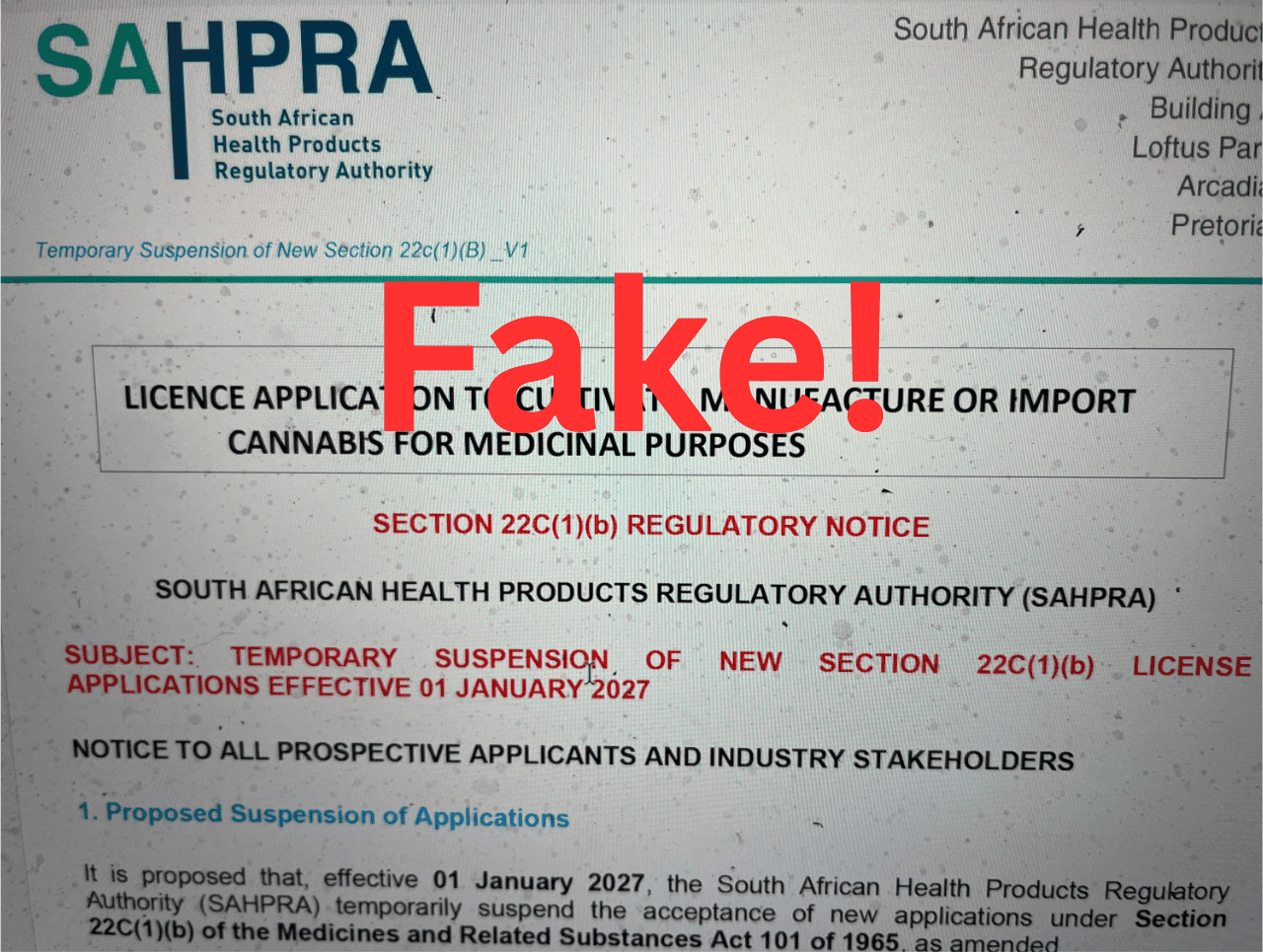
A fake SAHPRA notice went viral in the cannabis community this week – the authentic looking memo said that no further Section 22 cultivation licenses would be issued after 1 January 2027 pending an investigation into the abuse of license conditions.
Following hard on the heels of news of SAHPRA’s Section 21 clampdown (real), came the jolting news that SAHPRA is to halt issuing any new Section 22 licenses (fake), leaving stakeholders in the sector with their heads spinning.
Well, that got everybody sitting up and paying attention.
SAHPRA confirmed to the South African National Cannabis Association of Professionals (SANCAP) on 24 November 2026 that the Section 22c clampdown notice was fake.
The regulator says it intends holding a stakeholder webinar soon to clarify the situation around medical cannabis and the regulatory jurisdiction over non-medical cultivation. However, there is still confusion around patient access procedures following SAHPRA’s decision to clamp down Section 21 medical cannabis authorizations because of widespread abuse of the system.
SAHPRA’s Daphne Fafudi said on 18 November 2026 that Section 21 was to be reviewed as a medical cannabis access pathway and warned there were no retail shops allowed to operate under so-called SAHPRA authorization.
The fake news circulating hit a raw nerve in the cultivation space.
One cultivator, who wishes to remain anonymous, says the ‘fake news’ spooked him because it was entirely feasible: the regulator is indeed ‘cleaning up’ house. He said it was an open secret that many SAHPRA licensees were putting product that was meant to be for export into the local market and said he knew of at least two SAHPRA Section 22c licensees are under ‘investigation’ for not adhering to their license conditions.
The fake news communique said that no new Section 22c licenses would not be granted and that the whole situation would be investigated. “That’s not far off what’s actually going on, to be honest, we are expecting some form of communication from SAHPRA after it said it was tackling Section 21 abuse. It’s only a matter of time before they come after Section 22’s as well”.
SAHPRA has been motivated into self-scrutiny by unwelcome attention from Madlanga Commission investigators in October this year. Evidence was led at the Commission that SAHPRA licence holder Jack Frost Pharmaceuticals was enjoying ‘protection’ from taxi boss and alleged Big 5 cartel leader, Joe ‘Ferrari’ Siyaboni(?)
The Madlanga Commission has not yet responded to a mail from Cannabiz Africa asking whether SAHPRA itself is to be probed further by the Commission.
SAHPRA has limited capacity and other priorities – especially with the disruptions to the pharmaceutical supply chain creating a medicines shortage in the country. It has only 14 inspectors who work in teams of two, to cover the entire SAHPRA regulatory spectrum, and is relying on SAPS to take action against cannabis shops.
With the lack of any regulatory framework governing the local market, the retail ‘Grey Zone’ has become the proverbial wild west with estimates of over 10 000 outlets plying their gtrade around the country. Although the sale of cannabis remains strictly illegal, there is uncertainty within SAPS as to how to proceed with prosecutions as the removal of cannabis from the Drugs and Drug Trafficking Act will create a whole new legal landscape.
In the interim there has been a spike in police raids on cannabis outlets, with the situation all the more complicated because of the number of ‘fake cops’ doing the rounds offering shops ‘protection’ at asking prices anywhere between R5 000 and R40 000.
Many of these bogus cops have been unmasked by the threads running through the Cannabis Retail Association’s WhatsApp Group.
So welcome to a new era of ‘fake’. In the hall of smoke and mirrors, the lines between authenticity and falsehood are becoming increasingly blurred – and everyone it seems, is on the take.
#