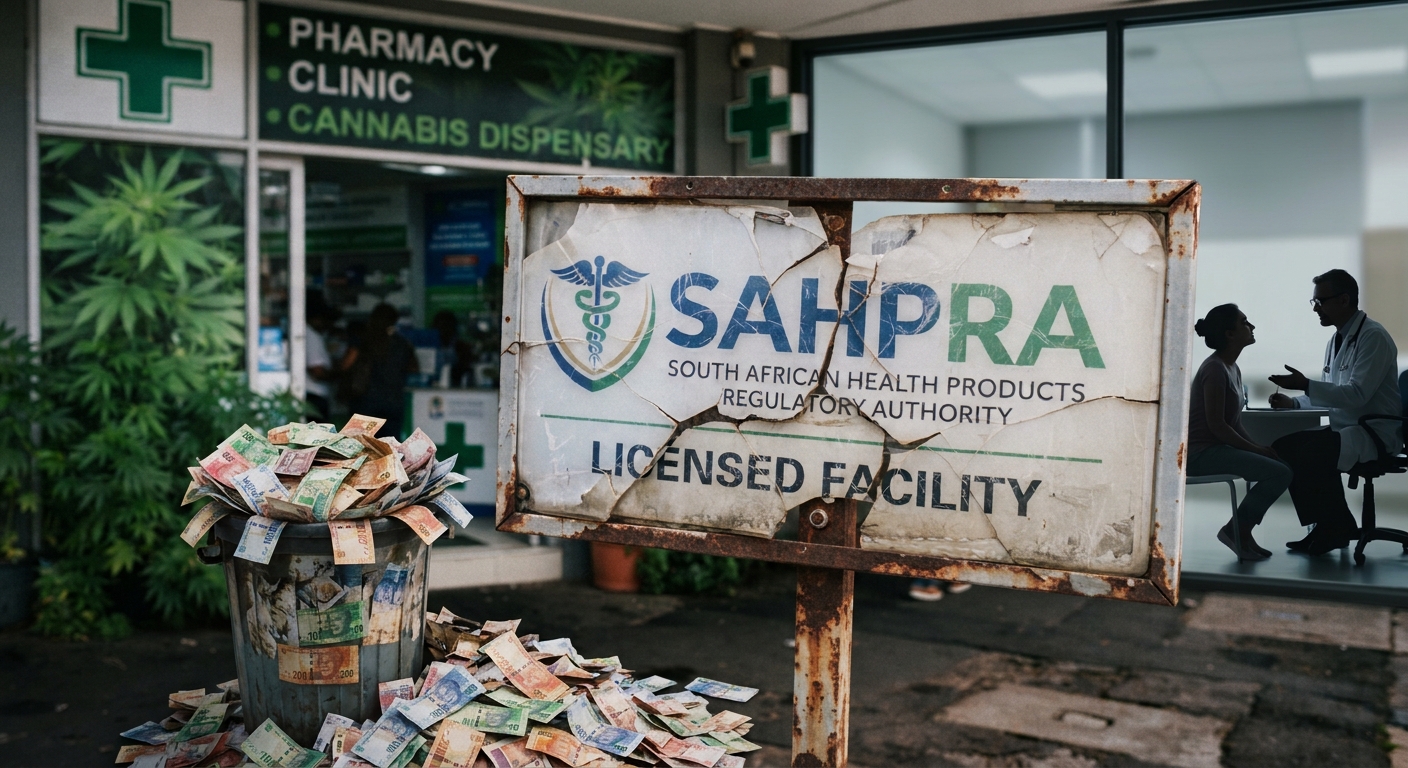
Cannabis Africa A1 generated image: SAHPRA on shaky scaffoding
The unfortunate reality is that the cannabis industry has rapidly become as complex as the plant itself.
This reality consists of non-pharmaceutical investors playing in an unfamiliar field, regulators navigating unfamiliar agricultural audits for pharmaceutical use, lines blurred by social clubs being a space for adults to consume but very clearly not legal under the ruling nor the Cannabis for Private Purposes Act (CfPP) and a greater population calling for responsible adult use legislation and inclusion of Indigenous Knowledge Systems (IKS).
Discord abounds in the industry where investors have spent millions of ZAR (retirement funds, personal funds, borrowed / loans etc) to build legitimate facilities to export or sell to bona fide Section 21 dispensaries.
Many have re-designed or retrofitted GMP buildings that did not meet process, people or product flow parameters because they were ill-informed. Advice has been forthcoming from countless cannabis “consultants” or “experts”, healthcare professionals either ill-equipped, suppressed or dominated by investors to invest in business models that were not sustainable.
Many were found themselves trying to release a high income crop without adequate safety information for the patient, sub-standard harvests and quality that was inadequate for international markets.
Rise of Grey Zone Inevitable Because of the System Was Designed Wrong
This has led to a flooding of the cannabis retail ‘Grey Zone’, which despite being illegal, continues to expand onto every street in every city in every province.
The only area with a modicum of control in the industry is the listed S22 cultivation license holders and a minute portion of compounding pharmacies dispensing manufactured bona fide cannabis pharmaceuticals.
Clubs and shops without regulatory oversight and regulated listing are much more difficult to manage and control.
The blanket halting of all Section 21 approvals is a disappointing but not surprising move by the regulator.
Section 21 [of the Medicines and related Substances Act 101 of 1965(MRSA)] has been severely abused by the illegal cannabis shops in South Africa. These shops have proliferated extensively under 100% illegal action – the Prince judgement of 2018 did not permit recreational use nor trade but the thread had to start somewhere and loopholing the system became common practice.
SAHPRA unfortunately exposed themselves by allowing Section 21 (quickly coined as #Tsek21 in SA cannabis circles) from these shops at an average of ZAR350/application on flower and pre-rolls. So began the “lie to get high” phenomenon in South Africa.
SAHPRA have clearly taken this blanketed stance over S21 because it is the one they have the least control over because none of the clubs nor shops are legal and the conversion to a legal operation via SAPC or SAHPRA costs considerably more than store space and a security gate.
Apart from the Board Notice (BN), issued by South African Pharmacy Council (SAPC), under Rule 2.29 (amended via Notice No. 669 of 2024) under Good Pharmacy Practice, pharmacies/dispensaries are restricted from retailing any products that conflict with health promotion (this includes electronic / vape devices, pouches etc.), pre-rolls and flower are not pharmaceutical dosage forms.
It appears that this approach provides control for SAHPRA, however, it speaks to a further resource issue in that SAPS are responsible for illicit trade and do not have the capacity, resources nor enough information on how the chain of custody to SAHPRA must be executed.
SAHPRA Appears to be in Upheaval Itself, That’s Not Helping
The lack of transparent communication to industry stakeholders and robust public information has caused further confusion, fragmentation and dissension in the South African cannabis industry, extending further to potential clients and buyers by decreasing their trust index in SA.
The recent mention of SAHPRA at the Madlanga Commission placed the regulator under further scrutiny when it emerged that a site had commenced operations before being issued a license by the regulator. This seemed to be the defining moment for the regulator and their stance on cannabis.
SAHPRA appears to be experiencing internal upheavals, as well as experiencing severe resource challenges. There are currently 14 inspectors responsible for auditing not only the now additional cannabis sites, but the existing non-cannabis pharmaceiutical – and medical devices companies.
The inspectors are mandated to travel in pairs for accountability, have been thrust into an agricultural sector without comprehensive guidelines and the additional pressure of a proliferation of clubs and shops – despite them all being illegal.
The increase in falsified, counterfeit and unauthorised non-cannabis products flooding the market has also created additional resource burden, resulting in a slower turn-around-time from the regulator on site audits, feedback and industry communication.
The regulator would have been under pressure from inception without considering capacitation for the new cannabis industry in South Africa.
Taking a Step Back, How Did We Get Here?
SAHPRA’s constitutional mandate after the Prince 2018 ruling is clear, a landmark judgement for cannabis in South Africa – it decriminalised cannabis, opened regulation for cultivation and export and provided opportunities for a plant that had literally been relegated to the basement.
The rulings appeared very specific in order to be packaged for regulators, healthcare professionals and SAPS, unfortunately, as with the tech industry, it ran ahead of itself and the need for greed became evident. If SAHPRA was implementing this framework, the directives and implementation should have been comprehensive and guided by the healthcare sector if the health regulator was leading the charge. This was not the case as became apparent a few months after the ruling.
A summary of regulations is required for context:
- investors / legitimate businesses could apply for cultivation licenses under section 22C of the MRSA to cultivate medicinal cannabis for export; – an intense administrative and pharmaceutical forensic exercise, a high investment risk in order to comply with existing MRSA and Pharmacy Act regulations and rules and one that was lead, in general, by investors with little to no healthcare regulation knowledge but a lot of capital.
- deschedule THC (psychoactive cannabinoid in cannabis) from S7 (illicit) to S6 [Habit Forming Drugs (HFD) – locked in a cabinet, logged in a register and balanced quarterly, reported annually to SAHPRA – in the same class as oxycodone, morphine, methylphenidate, pure codeine, medicinal cocaine; only dispensed by a pharmacist or pharmacist assistant under direct supervision of a pharmacist]
- schedule CBD (non-psycho-active cannabinoid in cannabis) above 600mg in a formulation to S4 (same category as the majority of pharmaceuticals requiring healthcare professional management – antibiotics, antihypertensives, thyroid, cholesterol, cardiac and immunosuppressants, inter alia).
- products containing less than 600mg CBD were to be considered and registered as Category D (supplements / complementary medicines). It is important to note that the wheels started wobbling early as the cap on CBD was initially 900mg by SAHPRA, prompting a number of prolific pharmaceutical companies to enter the market and flood health shops and pharmacy shelves with CBD isolate / untested products. Shortly after this, the cap on CBD was further lowered to 600mg, prompting mass recalls of the 900mg product off shelves, costing pharmaceutical companies millions.
- the rush to establish licensed facilities created the industry’s first buzzword of many ” the green rush”. Investors scrambled to form companies, buy properties / farms whilst at the same time trying to navigate complex pharmaceutical regulations (often without incurring the cost of a mandatory Responsible Pharmacist pre-license) as well as cGMP builds. This also saw a scourge of cannabis consultants entering a regulated market, many with also little to no healthcare experience advising multi-million rand transactions, layouts and designs, some resulting in retrospective builds, failed audits and additional costs incurred.
- 6) cultivation sites were required to comply with cGACP (current Good Agricultural and Collection Practices) as well as cGMP (current Good Manufacturing Practices) because SAHPRA is one of 51 PIC/s countries under WHO and is therefore incorporated into global standards. The inclusion of agricultural practices was an attractive inclusion for many experienced farmers wanting to diversify and expand, however, SAHPRA had to essentially learn as they audited because agricultural practices were not previously specified under their mandate. SAHPRA had engaged with DALRRD who were primed to conduct the GACP portion of the licensing process, but due to the lack of a robust framework incorporating healthcare and pharmaceutical principles, the full audit for licensing remained with SAHPRA.
- one of the essential requirements for license is a valid offtake (export) agreement. Many sites had to find, call on existing contacts, create new relationships and simply find new partners that would commit to buying a product 6-12 months before it would be tangible. This created the next wave: LOIs – Letters Of Intent (to buy a not yet existent product). SAHPRA eventually moved away from a simple LOI and added an additional audit step in that the offtaker would have to be subjected to a 30 minute SAHPRA peer interview and due diligence.
The above outlines the primary regulations from the ruling in order to highlight the arena and opportunity the industry was faced with.
A System Built to Fail
The ruling created a platform for a formidable industry of medicinal cannabis but unravelled as fast as licences were being issued, with very misaligned standards. SAHPRA were very clear in not prescribing layout, design, build or equipment styles, however outdoor cultivation is not permitted and processing (cGMP) is indicated to start from when the plant is removed from its substrate / growing medium ie harvest.
This convoluted state resulted in the following – bearing in mind that a site will only be audited by SAHPRA once FULLY equipped and operational (economic base industry information places these numbers at between ZAR15 million to ZAR330million):
- misaligned standards between sites (some sites spent maximum on indoor cultivation whilst others took an organic, living soil approach that has subsequently been denied by SAHPRA, without notification;
- nefarious people / businesses posing as offtakers;
- excess, unplanned expenditure on 2 -3 audits (SAHPRA only permits a maximum of 3 audits before a new application must be filed; SAHPRA auditors rates are charged per hour, per auditor plus a maximum of 4 hours of travel time);
- facilities becoming operational but inexperienced in scale resulting in crops that do not meet export standards resulting in product diversion to the illegal club and shop models;
- expensive testing costs;
- excessive administrative burden of non-compliant pharmaceutical risks;
- inexperienced healthcare professionals expected to navigate production of a previously illicit substance;
- circumvention of legislation and regulation in attempts to recuperate and ROI
And Then There is Section 21…
This highlight reel leads straight to the next buzzword: Section 21.
One can never blame the human race for not being creative….. enter the South African cannabis ‘Grey Zone’, of shops, social clubs and “dispensaries”.
A bona fide Section 21 is defined as a pharmaceutical molecule or dosage form not available in South Africa and therefore access requires:
- a valid healthcare professional prescription (in the case of S6 THC – an original written by the medical doctor in words and numbers);
- valid only for 30 days from the date on the prescription;
- no repeats permitted;
- presented to a pharmacist to dispense the exact quantity;
- and recorded by the pharmacist in a S6 register, balanced quarterly and reported to SAHPRA annually
It is important to note that pre-rolls / joints are not pharmaceutical dosage forms and therefore should never have been considered for Section 21. Some shops became confident enough that a consumer / patient could scan the QR code outside the shop, complete the online form presented (in lieu of a ” prescription”), choose from the displayed S6 flower bottles and have it “dispensed” by the person (non-healthcare professional) behind the counter and pay.
Only (very few) compounding pharmacies, like AKOS Bio, have legitimate pharmaceutical products that meet Section 21 criteria.
Conclusion
Medical cannabis cannot be regulated on its own without a broader adult-use framework in place. Otherwise the abuse of the system will just continue.
#