
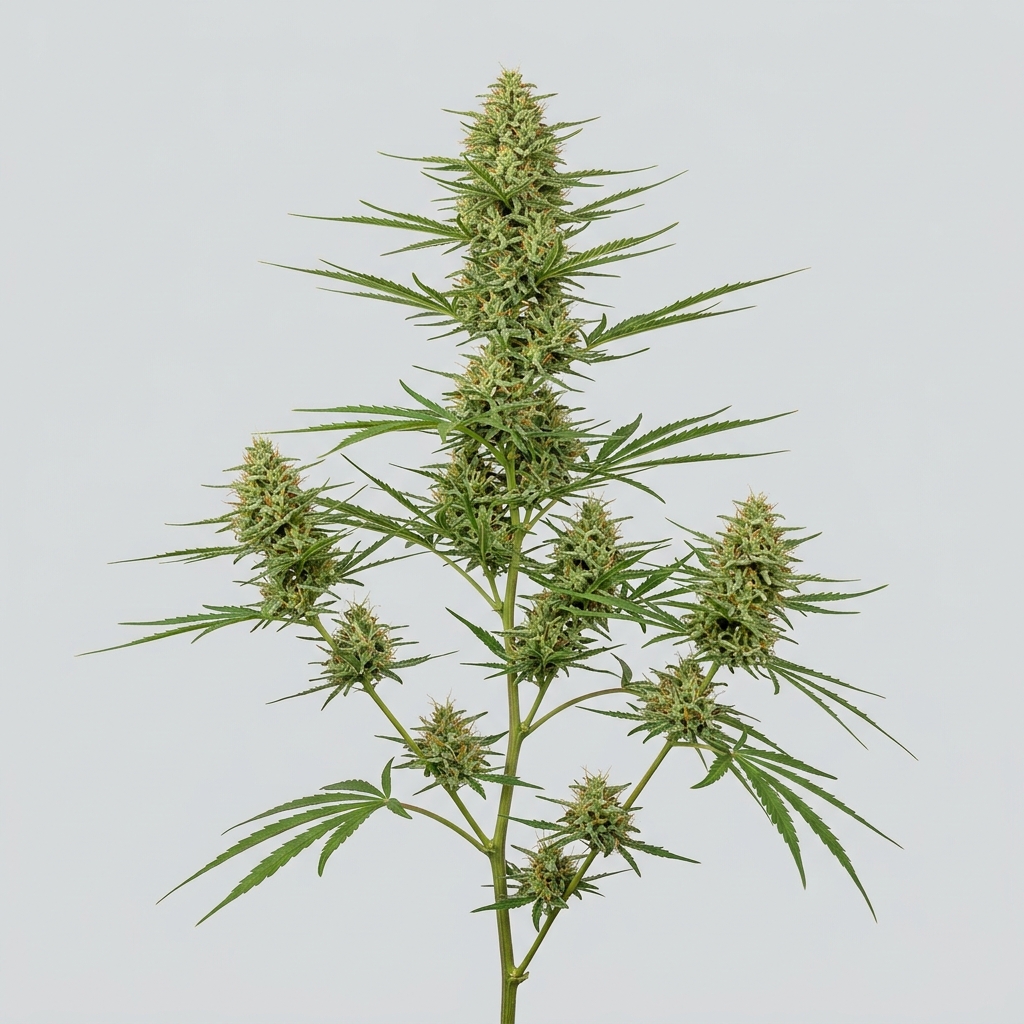
Pictured here KwaZulu Natal Landrace aka Durban Poison (courtesy Strainpedia)
This Deep Dive by the Sativa Landrace Team, published by Joint Commerce, December 2025.
Cannabinoid Profile and Minor Cannabinoids
As a preserved landrace sativa, KwaZulu Natal exhibits chemotypic variability, but certain patterns appear consistently. Market and lab reports for related Durban-type sativas commonly range from 15 to 22 percent THC by dry weight, or 150 to 220 milligrams per gram. CBD is typically low, often below 0.2 to 0.5 percent, with some outliers at or near trace levels.
A distinctive feature of many African sativas is the presence of THCV, and KwaZulu Natal is a strong candidate for THCV-forward expressions. Populations may show THCV in the range of approximately 0.2 to 1.2 percent by weight, corresponding to 2 to 12 milligrams per gram. These levels vary widely by phenotype and cultivation conditions, with landrace populations often showing coefficients of variation exceeding 20 to 40 percent.
Minor cannabinoids like CBG and CBC can appear in measurable traces. CBG commonly registers around 0.1 to 0.7 percent in representative sativa landraces under optimal light, while CBC may range from 0.1 to 0.3 percent. Such minors, though individually small, can influence perceived effect through entourage interactions.
Extraction runs conducted on comparable South African sativa material frequently report higher relative THCV yields when harvested at full maturity. Growers seeking THCV expression often allow an extra 7 to 10 days post initial ripe window, provided trichomes remain mostly cloudy with limited ambering. This approach can shift the ratio of acidic and neutral cannabinoids favorably for THCV recovery.
Terpene Profile and Quantitative Estimates
KwaZulu Natal’s terpene ensemble is typically led by terpinolene and ocimene families, with notable contributions from alpha-pinene and beta-caryophyllene. In Durban-type analogs, terpinolene can comprise 20 to 35 percent of the terpene fraction, with ocimene in the 5 to 15 percent band. Alpha-pinene and beta-pinene together may account for 10 to 20 percent, depending on environment and phenotype.
Limonene commonly appears between 2 and 8 percent of total terpenes, lifting the citrus top note. Beta-caryophyllene often anchors 5 to 12 percent, adding a peppery resin backbone along with potential CB2 receptor agonism. Minor yet impactful contributors like myrcene, humulene, and linalool typically register below 5 to 7 percent each.
Absolute terpene totals for well-grown material often range from 1.2 to 2.2 percent by weight, with outliers possible under high-light and optimized drying. The volatile nature of terpinolene and ocimene means post-harvest handling can dramatically alter the final ratios. Slow, cool curing is essential to retain the upper register that defines the strain’s character.
Phenotypic partitions sometimes emerge as citrus-forward, spice-forward, or herb-forward chemotypes. The citrus camp skews toward limonene and terpinolene, the spice camp toward beta-caryophyllene and humulene, and the herb camp toward pinene and ocimene. Breeders can select within the population to lock in a preferred direction over successive filial generations.
Experiential Effects and Use Patterns
KwaZulu Natal’s effect profile is energetic, clear, and outward-facing, aligning with classic African sativa experiences. Onset via inhalation is typically quick, often within 2 to 5 minutes, with a peak lasting 45 to 90 minutes and a tail extending to 2 to 3 hours.
Users report elevated mood, mental stimulation, and task engagement without heavy body load.
The cultivar’s THCV potential can contribute to a focus-forward and appetite-suppressing character in some phenotypes. Alpha-pinene and limonene may support alertness and perceived clarity, while terpinolene lends an effervescent lift. At higher doses, some users may experience racy or anxious edges, so titration is advised.
Compared with many indica-leaning hybrids, sedation is minimal, and nighttime use may be counterproductive for sleep. Daytime activities such as outdoor exploration, creative planning, or social gatherings often pair well with this profile. Workflows requiring ideation rather than fine-motor precision may benefit most from the mental momentum.
Tolerance develops along standard lines for THC-dominant cultivars, with frequent users noting diminished novelty within one to two weeks of daily use. Rotating chemotypes and observing periodic breaks can help maintain the strain’s signature clarity. Individuals sensitive to stimulatory sativas may prefer microdosing to capture lift without jitters.
Potential Medical Applications and Evidence
While controlled clinical data are limited for specific cultivars, KwaZulu Natal’s chemistry suggests several plausible therapeutic niches. The energetic and mood-lifting profile may help some users with fatigue and low motivation, particularly for activity initiation. Limonene and pinene have been associated in preclinical and observational contexts with mood and alertness support.
Low-level analgesia is possible, especially for mild neuropathic discomfort, though the strain is not typically chosen for heavy pain or sleep. Beta-caryophyllene’s CB2 agonism may contribute modestly to anti-inflammatory effects, and pinene’s bronchodilatory properties could be subjectively helpful for certain users. Individuals with anxiety sensitivity should proceed cautiously due to the stimulating character.
#




