
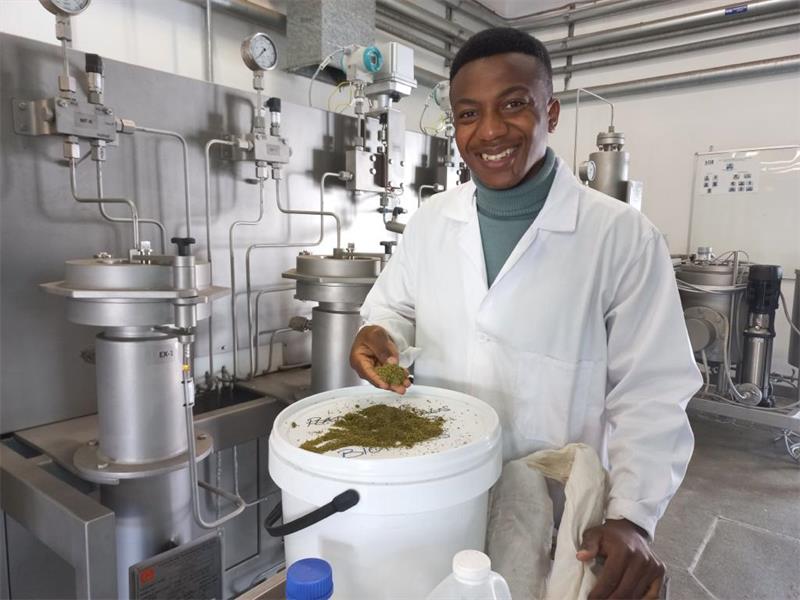
Pictured here: Cannabis Hub technologist Pollen Nkuna, image courtesy the Citizen.

Tshwane University of Technology and CSIR Cannabis Hub has launched the African Legacy Programme, which is one year into a landrace research project.
The unit, led by Professor David Katerere, aims to document and commercialise indigenous local seed heritage. The project aims to assist small-scale farmers in developing value-added products from their biomass, assist them to secure trademarks and patents and support their journey towards market-readiness.
For its part, the CSIR programme consulted two stakeholder communities in each of the country’s nine provinces and collected samples to process 18 different products and 100 market samples for each community.
The nationwide tour kicked off in Limpopo in April 2025 and then headed for Mpumalanga andcontinued across the rest of the provinces, terminating in the legendary Eastern Cape landrace heartland in July 2026. There team members met growers in Flagstaff and Lusikisiki.
CSIR Technologist (Process and Product Development): Pollen Nkuna said the programme had a twin-function:
· to document landrace strains peculiar to certain cannabis-growing locales in order to secure legacy farmers intellectual property for their varietals and
· to champion sustainable livelihoods for legacy growers and entrepreneurs through value-addition and product prototype development.
The three-member research team returned to headquarters with biomass to feed into the India-manufactured $250 000 (R4-million) Supercritical CO2 Fluid Extraction System (5 Liter) machine. The raw material first dries in the laboratory, is processed into crude and then purified into oil in the machine.
Nkuna showed me trays of dried cannabis he said was sourced from well known Eastern Cape cannabis farmer, entrepreneur and Abalimi Bomya Association founder Philasande Mahlakata.
This would produce a 10-15% yield or 3l-4l crude extraction, to be purified into oil.
Mahlakata’s Village Divah Organics carries a range of cannabis products, including body oils, creams, hairfood and bath salts, made from ingredients including mpepu and cannabis.
“Since it’s not for smoking, we don’t cure it because there’s no aroma to control,” said Nkuna, explaining that the legacy cannabis would be processed into cosmetics, neutraceuticals and complementary medicines on the TUT-CSIR jointly-operated Supercritical machine, depending on the crop’s chemical composition.
“We assist the growers by producing hundreds of value-added units which gives them higher returns, which is better than the occasional R5 they earn selling unprocessed stuff,” stated Nkuna.
#





