
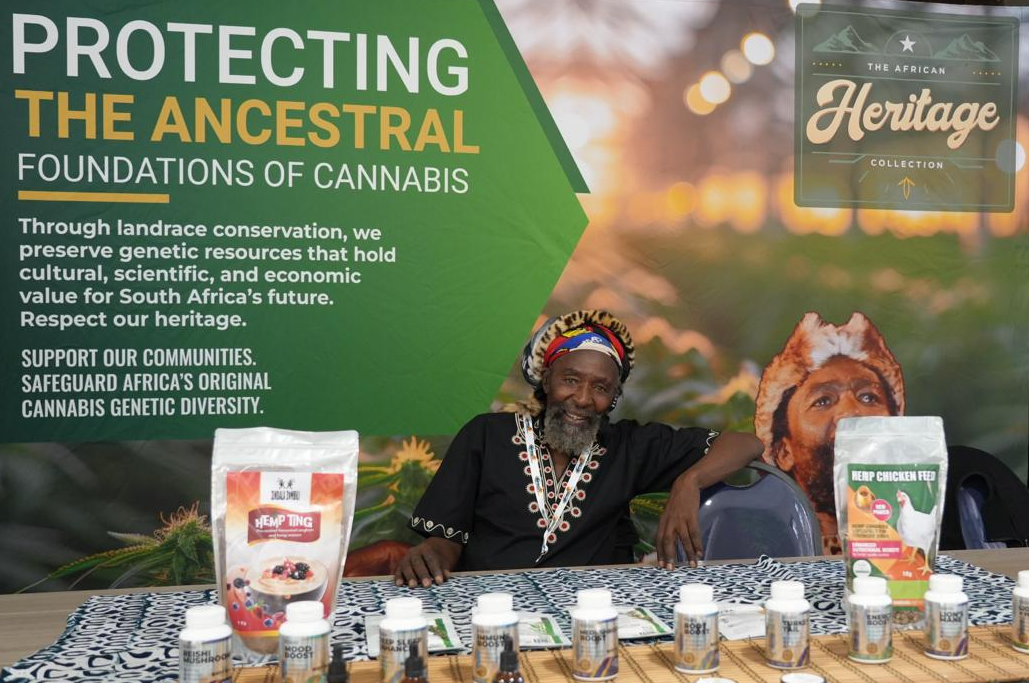
Pictured here:

African Cultural Heritage Trust president Qhuziline Sithole
South African landraces are rich in compounds that may be effective in treating a variety of ailments, such as breast cancer, epilepsy, diabetes, hypertension and chronic pain.
However, this rich genetic resource is in danger of disappearing as rampant, unregulated commercialism has resulted in an explosion of international and hybridized strains that have sidelined traditional growers and the cannabis they have been growing for generations.
Wrong policy direction locks away the medicinal benefits of landrace
Unlike Morocco, which has put its dominant landrace, Beldiya, at the centre of its cannabis framework, South Africa has gone the opposite route, aiming to replace indigenous cannabis cultivation with untested low THC varietals in the quest to develop a hemp economy. By doing so, the government is effectively undermining the intended beneficiaries of cannabis reform – the legacy farmers and their landraces.
Despite the fact that landraces such as ‘Durban Poison’ and ‘Mpondo Gold’ are recognized internationally as iconic strains used as the basis for hybridization, they do not feature in the Cannabis Master Plan and cultivation is deemed illegal unless produced within an SAHPRA-licensed facility for export purposes only.
The cruel irony is that our landraces have proven medicinal properties and have been used within indigenous knowledge systems for the last 200 years to treat a broad variety of ailments. Despite paying lip service to the value traditional healers play in community health, the Departments of Health has done little to unlock the benefits of African medicine, and have opted for western cannabis frameworks.
The Department of Agriculture says it has approved indigenous crops and medicinal plants as agricultural products in terms of the Marketing of Agricultural Products Act (No. 47 of 1996), and although former Agriculture Minister John Steenhuisen said this recognition would “unlock new opportunities for small-scale farmers, traditional healers, and rural communities”, nothing has materialized.
A handful of underfunded institutions are protecting landrace heritage
Instead, it has been left to a handful of institutions who have taken it upon themselves to protect and develop our landrace heritage. The two leaders in the field are the Tshwane University of Technology and CSIR Cannabis Hub, under Professor David Katerere, and the African Cultural Heritage Trust (see Facebook page here) which is supported by the African Farmers Association of SA, and is in partnership with Druids Garden.
Another project to protect and develop local genetics is underway in the Eastern Cape, where the Township Cannabis Incubator is being supported by numerous industry role players in collecting and studying local varietals. Mpondoland Cannabis Belt Association secretary general Snoux Poswa says one of the problems is the way cannabis is categorized.
He told a panel discussion at the Cheeba Summit earlier this year that landraces offered full-spectrum benefits, not just medical or recreational. He said that all landrace strains should be classified as ‘industrial cannabis’ despite having higher THC levels than the 2% ceiling for hemp. He said high THC levels should not stop landraces for being used for industrial and nutritional purposes.
‘Classify all landrace as industrial cannabis’
“All indigenous cannabis should be classified as industrial cannabis” says Kobus Schoeman of GrowOneAfrica, who has been working with the TCI and Mpondoland growers. He agrees with Poswa and says that the ‘full spectrum” approach to regulating the plant was accepted in principle at the Presidency’s Phakisa workshop held in June 2023. “Regulations should be determined by end use, whether it’s for industrial, medical or general adult use, rather than regulating the plant itself”.
Current regulations, and the lack thereof, are hampering both the protection and development of landrace strains. Eastern Cape lawyer Ricky Stone says government could solve the problem by making outdoor growing the default in a cannabis regulatory framework.
Currently SAHPRA is the only body that regulates cannabis with a THC level of higher than 2%. It awards cultivation licenses only to indoor/greendoor grows and for export purposes only, while the provincial departments of agriculture are responsible for issuing and administering hemp permits for cannabis with a THC component of less than 2%. There is no licensing framework for the several hundred thousand traditional growers and no legal market for their product or government support for communities to register the landraces they’ve grown as their own IP.
This has resulted in a mass exodus of indigenous genetics, with varietals such as Durban Poison, being ‘owned’ by international companies.
Mpondo Gold is an umbrella term for several landrace variations
Part of the problem is that we don’t really know what we are sitting on. Although the CSIR has identified 22 different indigenous landrace varieties, McClelland says the African Heritage Trust has found there are more than 40 different varieties.
Part of the landrace discovery process has revealed how nuanced the classifications are. Although ‘Mpondo Gold’ aka ‘Rooibaard’ is seen as a single landrace, an academic study led by Azile Dumane of Nelson Mandela University (Identification of Medicinal Cannabis landraces found in Lusikisiki, Eastern Cape Province, South Africa, 2024) (link) found that within this definition there were at least eight identifiable variations in the greater Lusikisiki area alone. Through informal interaction with villagers across the three villages, they found categorization of landraces was based quality and flower gender, with female plants prized for their medicinal qualities over male plants, and that different attributes came into play at different points in the seasonal cycle.
Therapeutic cannabis treatments vary according to use and region
Another study has found that there are regional patterns in the medicinal benefits of indigenous landraces.
- In KZN landraces, cannabis leaves have been used to treat hypertension (high blood pressure), ulcers, chest complaint, asthma and shortness of breath, promote weight loss, poisoning by ingestion (isidliso);
- In the Free State, leaves and flower have been used as a cure for asthma, bronchitis, headache, flu, epilepsy, cough, and pains,
- In Limpopo, leaves and stems are used in the treatment of treat impotency, diarrhoea, indigestion, epilepsy, insanity, and chronic diabetes
Dr Shiksha Gallow, who has piloted the first cannabis clinical trials in South Africa, says the medical benefits of indigenous cannabis have been part of ancestral knowledge for generations but this is being overlooked by government. She told ICS 2026 (link to CA story) that indigenous knowledge systems needed to be incorporated into modern public health regulations.
“The system has to include African traditional medicine, where cannabis has been used for generations for pain relief, menstrual comfort, anxiety and other ailments, usually in combination with other plants such as artemisia” she said.
African Cultural Heritage Trust president Qhuziline Sithole has appealed for landrace cannabis to be recognized as a heritage resource and has won the backing of mainstream agriculture through AFASA. He says the Trust and SACHIDA were aligned in advocating for the inclusion of landrace cannabis in future indigenous plant protection frameworks. He says such a framework should:
- Protect, conserve and promote South Africa’s landrace cannabis genetics;
- Return these genetics to the communities from which they originated;
- Support Indigenous Knowledge Systems (IKS);
- Advance biodiversity, cultural heritage, and community-based economic development.
#





