
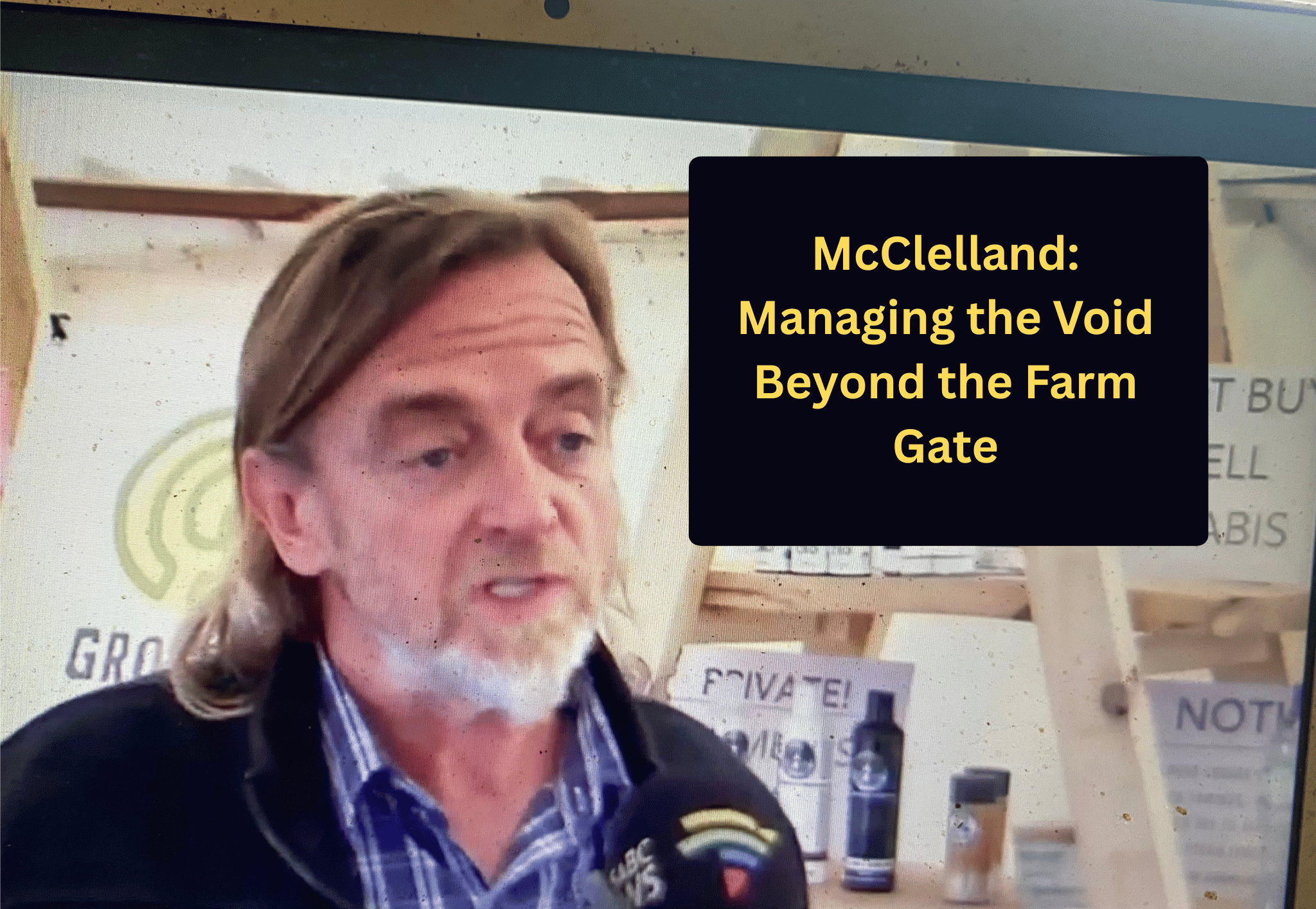
Cannabiz Africa hosted a webinar session on 11 September 2026, introducing multinational pharmaceutical company Oximio to key stakeholders in the local medical cannabis market. Oximio, which is a specialist clinical trials logistics, storage and distribution company operating in 50 countries, has established a South African operation, and is seeking to contribute foundational knowledge in the fledgling South African medical cannabis supply chain. Speaking on behalf of the South African Cannabis and Hemp Development Association (SACHIDA) , Deputy Chair Cian McClelland, who is also Druid’s Garden CEO, provided an overview of the logistics and distribution challenges in the local medical cannabis sector. Here he provides a SAHPRA-licensed cultivator’s perspective on holding a cannabis license, holding compliant product, and trying to get it to an actual patient.

The honest starting point for this conversation is that South Africa has licensed cultivators who can grow to a compliant standard. What we don’t yet have, in any mature sense, is a reliable, licensed, standardised route from that cultivator to that patient — and, as I’ll get to, even the parts of that route we thought we could rely on are shifting under us. Everything I’m going to talk about sits inside that gap.
Overview: the licensed cultivation landscape
• Licensed cultivation in South Africa runs on two separate SAHPRA instruments: a Section 22A permit, which is a research and development permit, and a Section 22C license, which authorises cultivation and manufacture. Druids Garden operates under both. They are not the same thing, and conflating them is one of the more persistent points of confusion — including, at times, in how our own compliance is characterised by third parties.
• On top of the license itself, cultivation has to meet Good Agricultural and Collection Practice — GACP — and anything moving toward a finished, patient-ready product has to meet Good Manufacturing Practice — GMP. Those are two different bars, and most licensed cultivators in this country are strong on the first and thin on the second.
So: real licensed cultivation capacity, sitting inside a two-tier regulatory structure. That capacity is not the problem. The problem is everything that’s supposed to happen after it..
The challenges: growing compliant product is not the hard part — everything after it is
1. The pace of legislative and regulatory change is itself the central problem
If there’s one message I want to send out it’s this one. The single biggest obstacle facing licensed cultivators right now isn’t cultivation, and it isn’t distribution technology — it’s that the legislation and regulations meant to govern this industry were supposed to have been settled years ago, and they still aren’t.
The clearest current example: Section 21 — the named-patient authorisation route that has been, in practice, the only real legal mechanism for patient access — is in the process of being discontinued. It is not yet clear what replaces it. For an industry that has spent years and significant capital building compliance around that mechanism, having it withdrawn before a replacement exists is about as destabilising as regulatory change gets.
And it isn’t an isolated case. The National Cannabis Master Plan, the regulations under the Cannabis for Private Purposes Act, and the DTIC’s separate commercialisation policy have all been years in development, with promulgation and finalisation repeatedly delayed — this against a constitutional clock that has effectively been running since the Prince judgment. SACHIDA, the industry body I sit on the executive of, has been coordinating member submissions on the latest draft Private Purposes Act regulations — necessary work, but also a reminder of how much of this framework is still not law, years after it should have been.
Every licensed operator in this room is trying to build GMP-standard cultivation and distribution infrastructure against a regulatory target that keeps moving. Capital does not flow confidently into that kind of uncertainty — and neither, frankly, does serious investment in the distribution infrastructure we’re here to discuss today.
2. The compliance and infrastructure gap for cultivators who are trying to do this properly
Even where the regulatory picture holds steady for a moment, the practical burden of getting from licensed cultivator to compliant, dispensable product is steep.
• The last-mile gap between GACP and GMP: a cultivator can be fully licensed and fully compliant at GACP standard, and still have no legal route to a patient, because the product hasn’t crossed into GMP-standard, patient-ready form. That conversion — biomass or extract into a dispensable, traceable, GMP-released product — requires manufacturing infrastructure, quality assurance systems and release testing that very few cultivators, ourselves included, have built in-house. This is exactly the gap a specialist distribution and handling partner is positioned to close.
• No shared distribution infrastructure: because there is no established third-party network yet, each licensed cultivator has historically had to build or buy their own compliant storage, their own cold chain where relevant, and their own track-and-trace system. That is expensive, duplicated across the industry, and a cost structure only the better-capitalised operators can absorb.
• Track-and-trace and compliance cost falling on smaller and legacy growers: seed-to-sale traceability is reasonable and necessary, but the systems to meet it are not cheap and not standardised — everyone is largely building or buying their own. For the smaller, community-based and Legacy Growers this industry says it wants to bring into the formal economy, that compliance cost is often the actual barrier to entry, not the cultivation itself.
3. The proliferation of private members’ clubs and shops, with real quality concerns
While compliant cultivators wait on a settled regulatory pathway, we’ve seen a rapid proliferation of private members’ clubs and cannabis shops operating in the private-use space the Prince judgment opened up. Some operate responsibly. Many do not. There is little to no consistent quality control, no oversight, and in a lot of cases no meaningful testing of what is actually being sold.
That matters on two levels. For the consumer or patient, it’s a genuine safety concern — someone walking into what looks like a legitimate outlet has no reliable way to know whether the product has been tested, correctly labelled, or grown to any standard at all. For licensed cultivators who have invested in GACP and GMP compliance, track-and-trace systems and proper distribution, it’s also a serious competitive distortion: informal, unregulated supply undercutting compliant supply on price, carrying none of the compliance cost.
The slower the formal legislative and commercial framework takes to finalise, the more that informal channel expands to fill the vacuum — and the harder it becomes to unwind once consumers are used to it.
4. The doctor bottleneck compounds all of the above
Even where a cultivator has compliant product ready to move and a functioning access mechanism exists, that access still depends on a doctor being willing and equipped to apply for authorisation on a patient’s behalf. Prescriber awareness and willingness is a separate problem from logistics and regulation, but it stacks on top of both: a perfect distribution network is still useless without prescribers at the other end of it.
5. The result
Put it together and this is the honest state of play: licensed cultivators sitting on compliant capacity; the one patient-access mechanism they’ve built around now being withdrawn with no defined replacement; a legislative and regulatory framework that was supposed to be settled years ago and still isn’t; and an unregulated retail channel that has grown to fill that vacuum, with real quality and safety implications. None of that can be solved alone. But a reliable, GMP-standard distribution layer is one of the few pieces of this puzzle that can actually be built now, regardless of how slowly the rest of it moves.
What would actually move this forward
• A firm, published regulatory timeline, with an explicit bridging mechanism for patient access if and when Section 21 is withdrawn — industry cannot plan capital investment, and patients cannot plan treatment, against an undefined gap.
• Shared, GMP-standard distribution and storage infrastructure, run by specialist third parties rather than rebuilt by every license holder — this is the single highest-leverage fix available right now, independent of how slowly the legislation moves.
• A clearer, single articulated pathway from Section 22A/22C licensing through to commercial supply, so cultivators can plan capital investment against a known route rather than a fragmented one.
• Clear demarcation and enforcement between the private-use space and the commercial medical supply chain, paired with baseline quality and testing standards extended into that informal retail channel — protecting patients and consumers regardless of which channel they end up using.
• Cost-sharing or capacity-building support to bring smaller and legacy growers up to GACP/GMP standards, so the formal industry doesn’t end up serving only those with capital to spare — which defeats the transformation objective this industry keeps stating.
• Standardised track-and-trace requirements across license holders, rather than each operator specifying and building a bespoke system.
• Doctor education and prescriber-pipeline development run in parallel with all of the above, since none of these fixes work in isolation.
• Industry bodies aggregating demand and coordinating on shared infrastructure and advocacy, rather than each license holder negotiating alone — this is part of why associations like SACHIDA exist, and it’s exactly the kind of coordination this sector needs on the distribution side specifically.
In Closing
So to bring it back to the technical and regulatory groundwork — GMP-standard storage, compliant handling, distribution discipline — is not a nice-to-have layered on top of cultivation.
For most licensed growers in this country, it’s the missing piece between having a compliant crop and having a patient who can actually access it, especially while the legislative side of this remains so unsettled
#





