
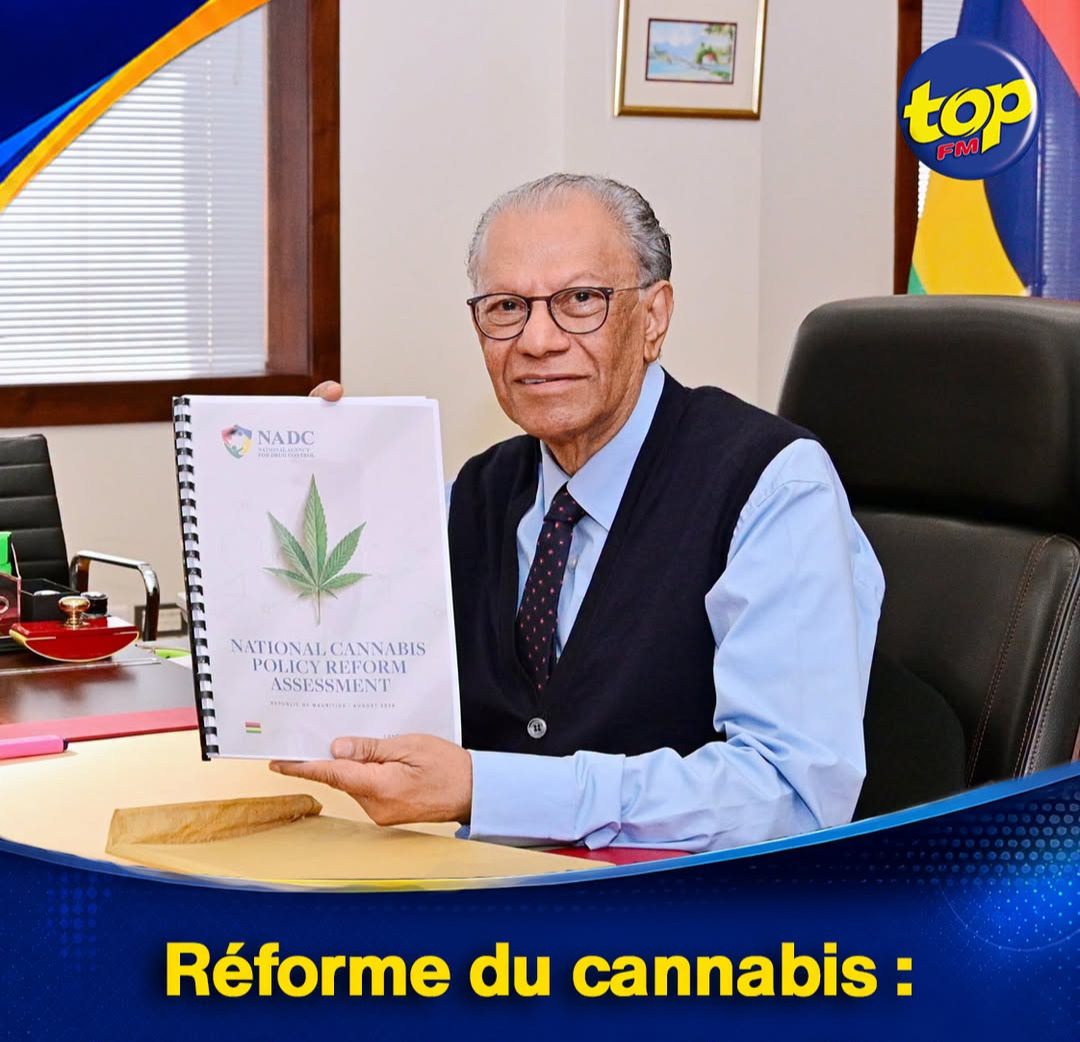
The report on the reform of the national policy on cannabis was presented to the Prime Minister, Dr Navinchandra Ramgoolam (pictured here), on 9 September 2026 by the Chairperson of the National Agency for Drug Control (NADC), Nadia Peerun, and its Chief Executive Officer, Kunal Naik, at the New Treasury Building in Port Louis.

In a statement following the meeting, Naik described the discussions as fruitful and stated that he had briefed the Prime Minister on the activities of the NADC, as well as the recommendations contained in the report.
He highlighted the broad and inclusive consultation process that informed the preparation of the report. Around 1,800 people contributed to the process, while focus group discussions were held with patients, people directly affected by drug use, as well as their parents and family members, he indicated.
National consultations also formed part of the process, with the various inputs gathered contributing to the drafting of the report.
Naik further pointed out that the report was prepared by specialists from various Ministries and stakeholder institutions, including the Attorney General’s Office, the National Human Rights Commission, the Forensic Science Laboratory and professionals in the field of medicines. He stressed that the report also takes into consideration the scientific aspects surrounding cannabis.
Regarding the way forward, Naik stated that a meeting of the National Drug Control Commission, chaired by the Prime Minister, will be held to present the report to members of the Commission. The report will subsequently be submitted to Cabinet.
He also briefed the Prime Minister on the current drug situation in Mauritius, including the various challenges being encountered, the measures the NADC intends to undertake and the obstacles hindering the Agency in carrying out its work. Mr Naik highlighted that the Prime Minister had assured him of his support for the cause and for addressing the challenges confronting the NADC
French online publication Newsweed’s Aurelien Bernard, provides some background:
Three options under consideration as early as this spring
In early 2026, the NADC announced that it was preparing a public consultation dedicated to the future of cannabis policy.
Three scenarios were then examined: decriminalization, legalization without criminal penalties, and legalization accompanied by a regulatory framework. These concepts may seem similar at first glance, but they encompass different legal realities.
At this stage, no final decision had been made. The government was to make a decision after reviewing the findings of a working group composed of researchers, representatives of the judicial authorities, NGOs, and technical experts, among others.
In May 2026, the NADC officially launched this project. The work was to cover recreational uses and medical, the industrial potential, as well as the social and cultural consequences of existing legislation. Particular attention was paid to the effects of criminalization on certain populations, notably the Rastafarians.
The public consultation, which was organized in the spring and later expanded to include various segments of the population, was intended to allow for a comparison of scientific data with the realities on the ground.
In July 2026, the first element of the reform began to take shape around the Drug Users Administrative Panel (DUAP). Created by the Dangerous Drugs (Amendment) Act of 2022, under certain conditions, this program allows individuals arrested for possession for personal use to be referred to a treatment program rather than facing traditional legal proceedings.
However, the mechanism has a major flaw: the law does not establish a specific threshold for distinguishing between a user and a person suspected of trafficking. The decision therefore rests largely on an assessment of the circumstances and the judgment of the competent authorities.
This lack of a legal threshold has been criticized by several industry stakeholders, who are calling for greater safeguards, transparency, and predictability in the implementation of the system.
A report that now supports decriminalization
The final report, prepared by a technical group of 12 experts under the leadership of NADC CEO Kunal Naik, now seems to be going even further than a simple amendment to the DUAP.
In particular, experts examined the impact of current policy on the prison system. According to the data analyzed, approximately 80% of those incarcerated for drug-related offenses are in prison for possession rather than trafficking. This finding fuels the debate over the appropriateness of a primarily criminal justice-based response to drug use.
The group also compared the experiences of several countries and assessed the capacity of Mauritius’s judicial, health, and social institutions to support a potential reform.
However, the exact details of the recommendation and its scope remain to be seen.
#





