
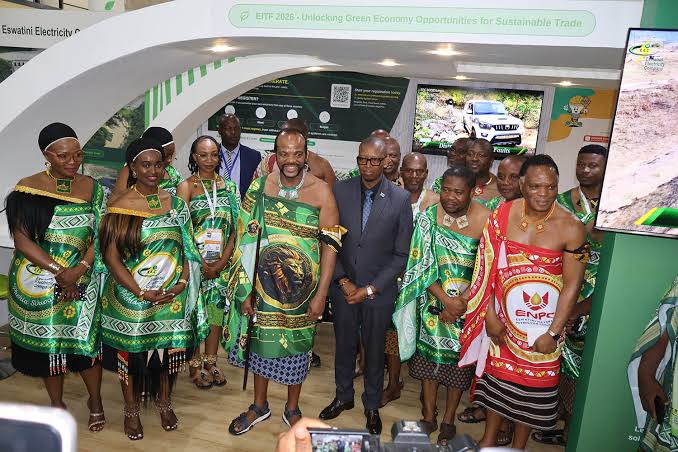
Pictured here: King Mswati II’s delegation at the eSwatini Internationa Trade Fair.

eSwatini is just getting out of the starting blocks in the hemp industry and an industrial and medical cannabis framework is being drawn up by Parliament. A hemp adaptability trial pilot project with African Hemp Development and Management (Pty) Ltd (AHDM) was endorsed by Cabinet on 6 July 2026. Botha and Mkhabela are directors of the company which is conducting the trials with the University of eSwatini.
The company’s directors met King Mswati at their stand at the Eswatini International Trade Fair (EITF), held at Mavuso Trade and Exhibition Centre on 4 September 2026. They took the opportunity to highlight the potential economic benefits the country could reap once a viable cannabis industry framework was established, pointing out it could be a game-changer for the country.
During the meeting Botha and Mkhabela proposed to the King that eSwatini host an international cannabis summit in the country next year. They said this would play a valuable role in encouraging South Africa, eSwatini, Lesotho, Botswana, Zimbabwe, Zambia and Namibia to share knowledge and exchange ideas on developing a regional cannabis and hemp producer bloc in the region.
eSwatini Agriculture Minister Mandla Tshawuka, who accompanied the King during his visit to the Trade Fair, is responsible for developing an industrial hemp framework for eSwatini, and supports the idea of a SADC cannabis roundtable. He said countries at the Fair included those that had legalized cannabis or hemp, such as Canada, the United States, France and Ireland.
AHDM’s Mkhabela said the project sought to change perceptions around cannabis and help Emaswati understand the distinction between THC cannabis and industrial hemp. “We came here so that we can meet His Majesty King Mswati III and make a presentation to him.” He added that the Ministry of Agriculture had tasked him and Botha with conducting research and development aimed at improving public understanding of the potential applications of industrial hemp.
Mkhabela said industrial hemp could support the development of a broad range of products and create opportunities across agriculture, manufacturing, fabrics, textiles, construction, fertilizer, bioplastics, paper and food products amongst others.
He said the project would focus on adding value to biomass. “We want to avoid taking raw materials outside. We are all about the value chain,” he said.
He said a cannabis workshop had been scheduled for next month to bring together stakeholders and experts and map a way forward for the country’s industry.
At the Trade Fair, Agriculture Minister Tshawuka expressed hope that the Cannabis Bill would be enacted soon as a clear legal framework was agreed on. He said the country first had to repeal prohibitive colonial-era legislation in order to open up the value chain before cannabis commercialisation and industrialisation could take place.
eSwatini’s industrial and cannabis framework is under development, but at this stage it does not envisage any relaxation of prohibition on general adult-use consumption. It also does not have a strategy of dealing with the country’s most renowned cannabis asset, its indigenous Swazi Gold landrace.
eSwatini is one of Africa’s top producers of illicit cannabis, supplying not only the South African ‘Grey Zone’ with its ‘budget weed’, but also smuggling networks in Zimbabwe, Botswana and further afield.
#





