
The MBOSA National Cannabis Dialogue in Kempton Park on 27 August 28 achieved something South Africa’s cannabis sector has needed for years: it brought the people living with the consequences of cannabis policy into direct conversation with the departments responsible for implementing it.
Traditional leaders, indigenous cultivators, informal traders, community organisations, researchers, legal specialists, activists, commercial participants and government officials were all confronting the same basic contradiction. South Africa recognises important private cannabis rights, speaks openly about commercialisation and promotes the plant as an economic opportunity, yet the lawful chain connecting cultivation, processing, sale, purchase and the final consumer remains incomplete.

For people already operating in the sector, this is not a theoretical problem. Farmers are encouraged to participate in the cannabis economy while remaining uncertain about lawful routes to processing, transport and customers. Businesses must navigate overlapping regulatory regimes. Traditional growers and communities that preserved cannabis knowledge and genetics through generations of prohibition are told they should participate in the future industry without yet being given a practical route into it.
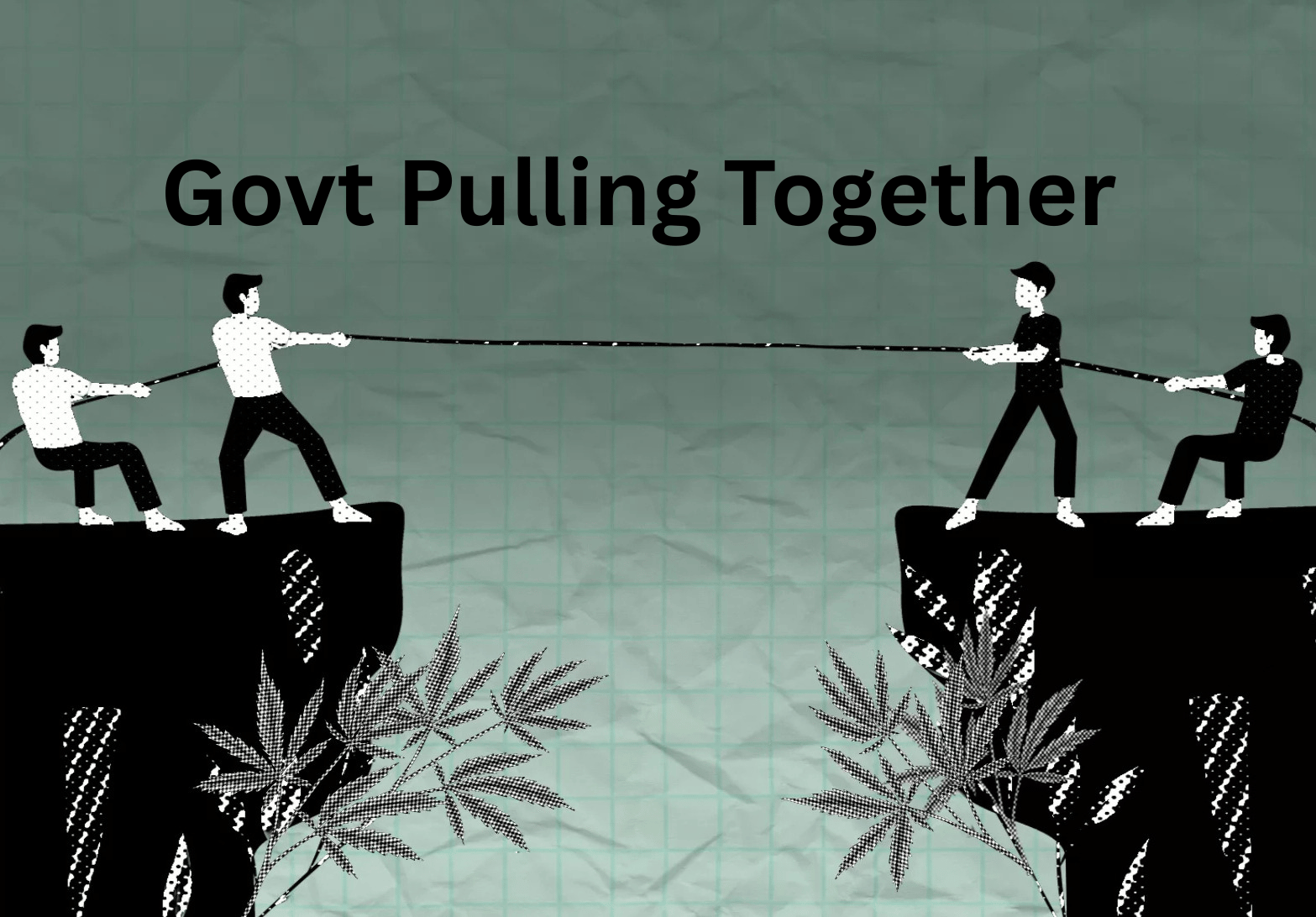
The dialogue exposed why departmental fragmentation has become one of the central obstacles to implementation.
The Department of Justice explained that creating the commercial framework for cannabis sale and purchase does not fall within its mandate and pointed towards the Department of Trade, Industry and Competition’s commercialisation work. Within government’s internal division of responsibilities that may be correct, but the people affected by cannabis law do not experience the state as a series of separate mandates.
A cultivator facing confiscation, an informal trader confronted by police or a farmer trying to understand how a crop may lawfully reach a customer cannot solve the problem by being referred from Justice to Trade and Industry, then Agriculture, Health or SAPS. Government may divide responsibility between departments, but the industry experiences the result as one regulatory system.
The policing discussion revealed the same problem from another direction. Participants heard confirmation that private adult possession, cultivation and use are not prohibited, while dealing remains an offence. The difficulty is the boundary between protected private conduct and conduct regarded as dealing, particularly when that boundary is not understood or applied consistently in practice.
That uncertainty continues to create the conditions for searches, confiscations, arrests and conflict between communities and law enforcement. National guidance and practical training are needed so that constitutional rights do not depend on the interpretation prevailing at a particular police station.
For the cannabis sector, however, the most important part of the dialogue may have been the discussion around inclusion.
South Africa cannot claim to be transforming cannabis if legacy growers, traditional healers, indigenous communities and informal participants are recognised in policy documents but excluded from lawful market access. Inclusion requires more than invitations to meetings or references to heritage. It requires affordable compliance, access to finance, processing infrastructure, protection of indigenous genetics and a realistic route through the value chain.
If ordinary growers cannot lawfully reach customers, South Africa will not have transformed the cannabis economy. It will simply have transferred control.
That is why the absence of an immediate government solution should not be treated as a failure of the MBOSA dialogue. Its value was that the contradictions were placed on the table in front of government, communities and industry at the same time.
The questions are now difficult to avoid. Who may lawfully sell cannabis? Who may purchase it? What must happen between cultivation and the final consumer? Which department is responsible for closing each regulatory gap, and what protection exists for affected people while those departments complete the work?
Those questions should now become an implementation programme rather than another round of consultation.
The meeting identified four areas around which further advocacy can be organised: protection from inappropriate enforcement while the framework is being corrected; development of an inclusive commercial economy aligned with national policy; protection of indigenous knowledge and genetic heritage; and recognition of religious, cultural and traditional rights.
The next stage should be practical and measurable.
H3 has proposed that the unresolved issues emerging from the dialogue be placed into a formal implementation register. Each issue should identify the responsible department, the legal or administrative instrument required, any dependencies on other departments and a deadline for completion. Government should then return to the same table and report against that register, with civil society, legacy communities and industry remaining part of the process.
Interim protection needs the same level of precision. This is not an argument that existing prohibitions should simply be ignored. It is an argument that people should not continue carrying the cost of regulatory gaps that government itself acknowledges remain unresolved. Lawful mechanisms that reduce enforcement uncertainty and protect legitimate activity during the transition should form part of the implementation discussion.
The strongest outcome of the MBOSA dialogue was therefore not a new policy announcement. It was the fact that South Africa’s cannabis contradictions were placed directly before the institutions responsible for resolving them.
The meeting made it harder for any department to say that the problems are unknown, or that responsibility lies entirely somewhere else.
South Africa already has the growers, knowledge, entrepreneurs, researchers, communities and economic interest required to build a workable cannabis sector. What remains missing is a coordinated route from policy to implementation.
MBOSA has helped move the national conversation beyond whether reform is necessary.
The next question is far more important for the people already living and working in this economy: who will take responsibility for completing the framework, and by when?
Charl Botha (B.Proc) is a legal strategist, cannabis policy specialist, and co-founder of H3 Legal Solutions (Pty) Ltd. He has briefed Parliament on cannabis policy and industrialisation matters in South Africa.





