
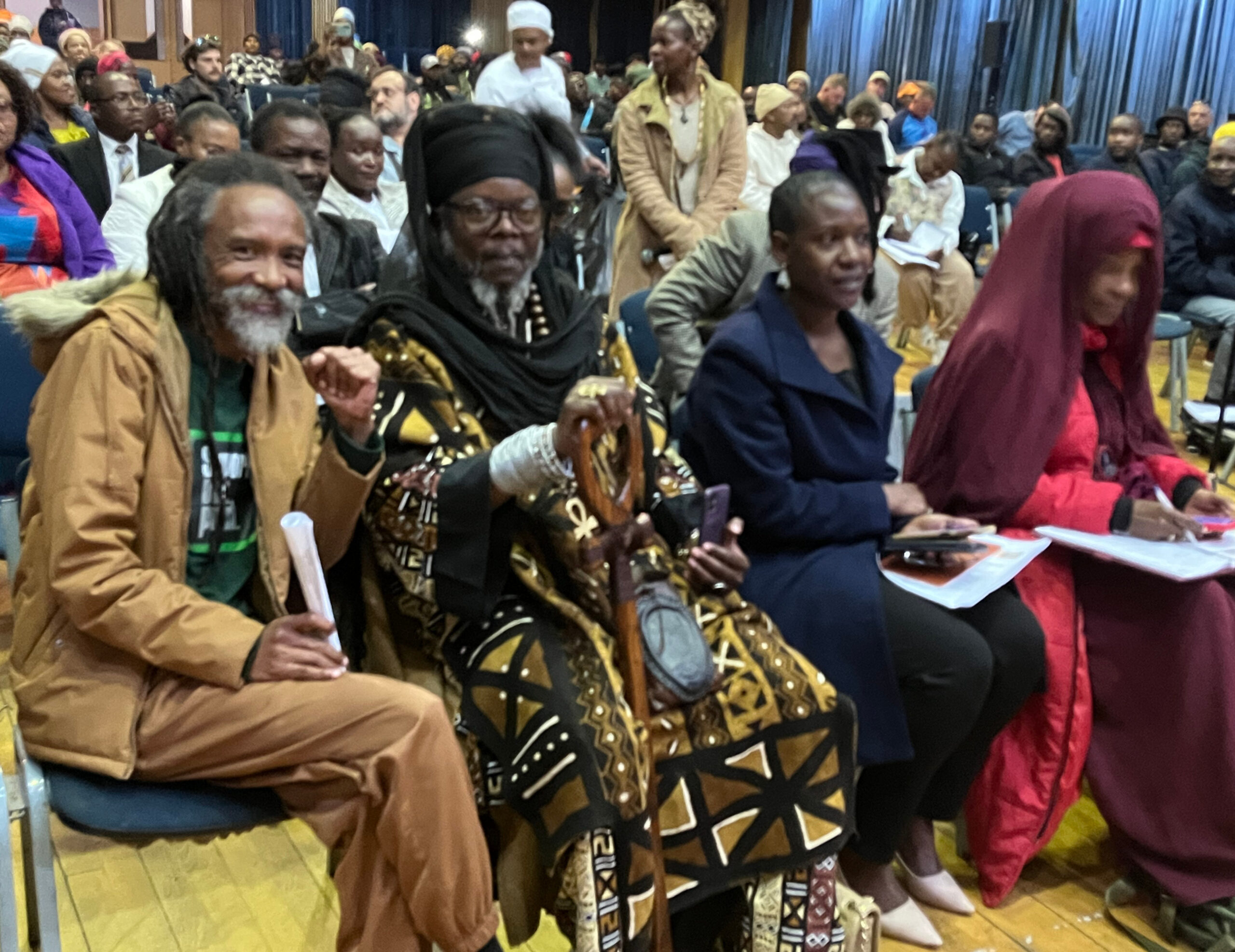
Pictured here: Ras Gareth Prince (left) and other delegates at the NCD.

The Marijuana Board of South Africa’s (MBOSA) bold attempt to move cannabis reform forward by facilitating the engagement between stakeholder organizations and various government agencies was well-intentioned. MBOSA managed to get commitments from key government departments to meet a broad cross-section of grassroots organizations under one roof, under the auspices of the National Dialogue. A representative from the presidency even attended the NCD’s media briefing last week, confirming his attendance.
Despite having no budget to transport or accommodate the many people from rural areas across the country, the MBOSA and NCD organizers pulled the show together at the Kempton Park City Hall on 27 August 2026 with over 200 delegates arriving for the one-day summit. Among them was SA Cannabis Development Council chair Gareth Prince, one of the applicants behind the urgent Western Cape High Court application, who’d agreed to hold back on legal action after state lawyers persuaded them to take the negotiation route.
Concerns About What Was Happening Outside the Room
There was an air of expectation as delegates gathered ahead of the opening. This was finally government’s chance to answer the many questions raised by the cannabis community, particularly relating to grassroots entrepreneurs, small businesses and rural communities who have been marginalized by reform efforts.
But as delegates chatted and sipped their coffee, disturbing news began to filter through. The main note of concern was the resignation the day before of the DTIC’s project manager of the National Cannabis Master Plan, John Jeffery.
Jeffery gave no reasons for his resignation which came as a shock to the cannabis community as he had become government’s point person in accommodating private stakeholders in the National Cannabis Master Plan (NCMP).
His decision to quit may have been a factor in the DTIC’s no-show at the Dialogue, but the fact that the Department had no back up and squandered the opportunity to participate in the Dialogue, is indicative of the disfunction that characterizes all government departments who are meant to participate in the NCMP.
The more disturbing news delegates were talking about came from Pretoria, where there have been several SAPS raids on at least seven cannabis outlets in the recent past, despite owners attempting to be compliant. Delegates also talked about a noticeable uptick of scamsters pretending to be police officers and demanding protection money
“Isn’t it time to push back against law enforcement a bit more aggressively?” someone asked MBOSA’s Ras Thapea Khunou who was one of the organizers behind the event.
“No my brother, the only way is mediation” was his response. “That’s why we are here. The cops and the people they police often come from the same communities, they have to be able to live together even though the law right now does not let them”.
Major No Show by the Officials Who Really Should Have Been There
With the stage set, and the anxiety beginning to mount, the National Dialogue kicked off, but, perhaps unsurprising,y, the main players did not turn up to pay their part.
Despite having confirmed that it would attend, the Presidency did not. Neither did the National Prosecuting Authority which is allegedly working on new policing guidelines for cannabis, nor the Department of Health or SAHPRA attend despite invitations being sent.
The opening address was meant to be by the Gauteng premier Panyaza Lesufi, but he instead sent his good wishes; the mayor of Ekurhuleni, Alderman Nkosindiphile Xhakaza, also had more urgent matters elsewhere and failed to arrive – but did supply the sandwiches.
Mpondoand Cannabis Belt Association secretary general Snoux Poswa welcomed what delegates there were from the government: “To those of you who feel you may have been thrown in the deep end, don’t worry we are not dangerous. We are actually the kind of people you want to build a nation with”.
The most senior official from government was Makubela Mokulubete , from the Justice Department. He has been riding point on the Cannabis for Private Purposes Act. He told delegates that 2 807 submissions had been received on the draft regulations for the Act and these were being incorporated into the final version.
“I have revised the regulations, once they are published, you will see the incorporation of some of the public input,” said Mokulubete.
But the man whose lawsuit ushered in private purpose use would have none of it.
“How do I exercise my right to use cannabis without a legal source?” Ras Gareth Prince asked Mokulubete, who didn’t really have an answer.
The SACDC chair called for one overarching law to regulate cannabis, including recreational use as well as medicinal and industrial purposes.
“If you’re on the side of medicinal cannabis and hemp you are okay, if you’re on the side of dagga it’s prison for you,” he lamented, citing Article 237 of the Constitution which calls for all constitutional obligations to be performed without delay.
Dubbed The National Consensus on SMMEs, Informal Economy, Cannabis and Hemp Sector Dialogue, the event was characterised by robust and animated discussions around police harassment, unlawful arrests, delayed regulations, commercialization and the right to earn a livelihood through job creation and SMME support.
House of Hemp founder Dr Thandeka Kunene presided over the resolution-making process with delegates affirming appropriate issues unanimously. These included a suggestion to hike local hemp THC threshold from 2% to 7%.
Dialogue Highlights:
– A call for cannabis’s removal from the Drug and Drug Trafficking Act.
– Prince requested that the 2023 SAPS cannabis arrest moratorium be made an Order of Court; Rasta consultation on police Standard Operation Procedures (SOPs) and re-educating SAPS members on cannabis policing.
– Moderator Snoux Poswa asked government to speed up regulations’ finalisation and called on departments to be compassionate and avoid inter-departmental deference of responsibility
– Delegates also called for possession limit amounts to be abolished.
– Justice Ministry representative Makubela Mokulubete said personal consumption amount limits had been included under regulations and removed from the CfPPA in order to speed up the legislative process and revealed plans to expunge cannabis criminal records.
– Landraces had to be protected from foreign cultivars in order to preserve legacy communities. “We don’t want hemp from France planted next to Pondo gold,” stated Kunene.
– The Phakisa Sandbox scheme under the Indigenous Knowledge System (IKS) Act needed to be unified and strengthened.
– Citizens should report corrupt police to a dedicated complaints directorate.
– Police said they would continue arrests for dealing in terms of current legal provisions.
Delegates expressed their appreciation to MBOSA and the NCD organizers for succesfully putting in the hard yards and bringing trhe community together.
MBOSA executive member Ras Thapelo Khunou said stakeholders would come up with their own action plan in the face of government’s inability to address key concerns. He said draft resolutions from the National Dialogue would be drafted in the coming month and published within 90 days.
#





