
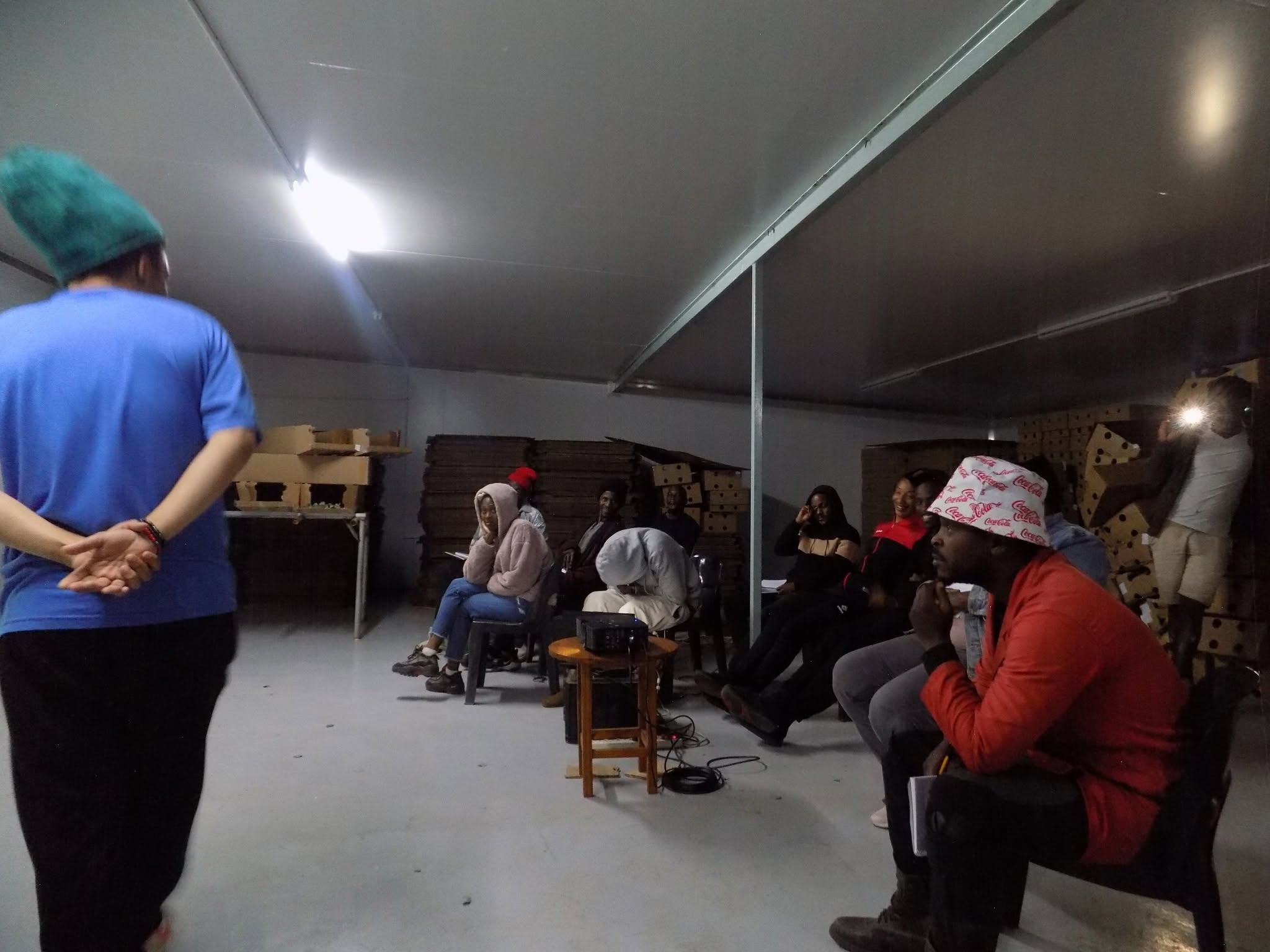
(Pictured here: SAIDC/MBOSA information sharing session facilitated by local government)

The local government structures of Warden and Qwaqwa in the eastern Free State recently facilitated industrial cannabis farmer training workshops driven by the South African Indigenous Dacha Consortium (SAIDC) and Marijuana Board of South Africa (MBOSA). The organizations have been criss-crossing the country to teach farmers the hemp basics, from seed selection and cultivation to the whole plant lifecycle as the planting season gets into high gear. They have been supported by several municipalities in trying to build the foundations of an industrial cannabis rural economy.
SAIDC’s Earl Dacha-San tells Cannabiz Africa that Qwaqwa and Warden training sessions were part of a national ’sandbox’ project to empower indigenous communities through education and training, He says that a successful grassroots strategy of getting cannabis communities to work with officials at municipal and provincial levels could be replicated nationally, provided Dacha-San said, “so we can set up an industry and work together as a nation”.
He said communities responded positively to the training workshops in the eastern Free State and other rural areas afficated by poverty and joblessness.
“We had a nice turn out, people from all age groups attended, lots of farmers with hemp permits, more people actually wanted to come, hence we are planning to go back to Qwaqwa and Warden in the next two weeks,” he says.
“The community is eager to learn. It has the land ready to start the cultivation training. They have infrastructure that can possibly make them a hemp processing hub of South Africa.”
SAIDC and MBOSA’s programme is due to visit Zuurbekom in Limpopo in the near future.
The workshops are being held in line with the Phakisa Action Lab recommendations from 2023, amongst which were the creation of ‘sandboxes’ – designated zones where existing rules and regulations may be waivered in the interests of innovation and market development in a specific sector.
Dacha-San says the main objective is to prepare communities for what he calls the creation of a “dacha value chain”.
“This has been the core of our training. We conduct weekly provincial workshops. Wednesday evenings we have a segment called Discussions with Dacha-San, at 19:00. This is a platform for sharing information and updating the dacha community at large,” he said. By way of example, Mpumalanga stakeholders had a training slot on 12 October and their Free State and Gauteng counterparts on 13 October 2026.
Dacha-San also cited a youth-development program on Saturday mornings “where we identify opportunities for the youth within the newly emerging dacha industry”. Sundays were for a women empowerment program designed to help women identify herbs and to teach them essential oils extraction and product manufacturing. “The online workshops have helped us a lot in accomplishing our goals,” he said.
“The biggest challenge is education. People have very little knowledge when it comes to this plant. The other challenge is the hemp permit holders who don’t have access to seeds and have invested a lot of capital for nothing.”
Dacha-San said pans were underway to train farmers in crop science and expose them to existing farming operations in their areas. On site training was essential he said as most rural communities had connectivity challenges.
He said training went beyond cultivation into product-processing training.
“Two years ago we started a program with the Cannabis and Hemp Association of Mpumalanga (CHAM) where we trained farmers to process dacha into multiple products. CHAM has successfully started a cosmetics range, a healthcare range as well as a perfume range,”
#





