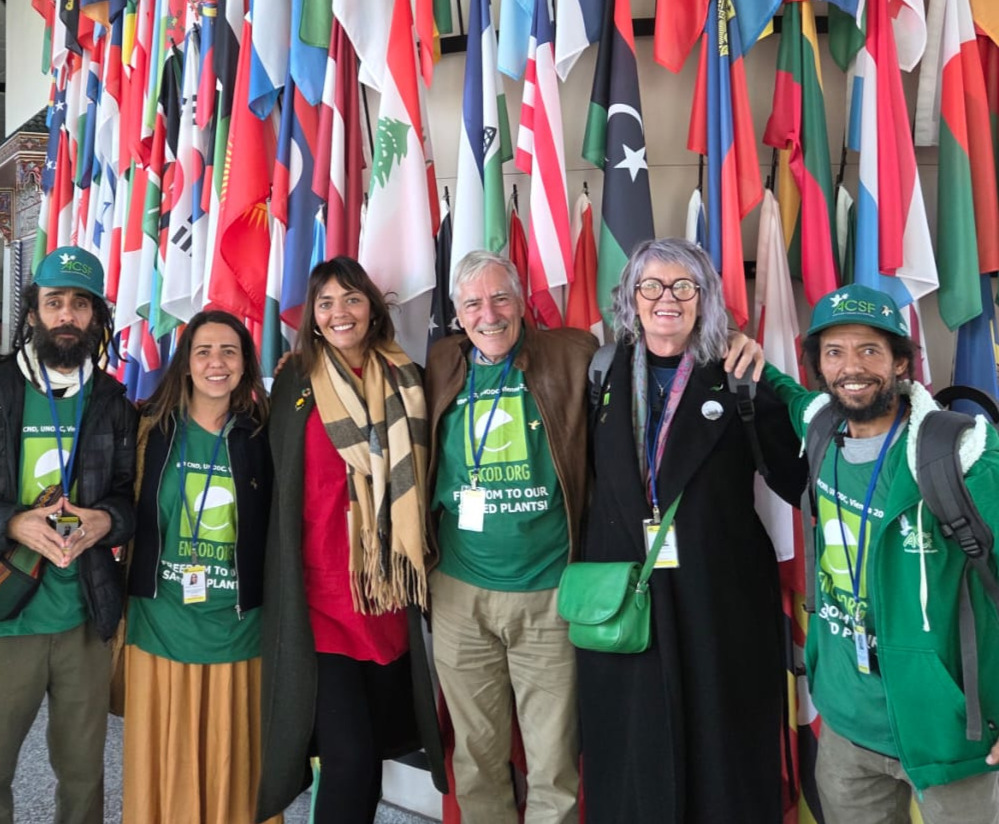
Pictured here, courtesy FGFA: The FGFA team at last year’s UN CND conference
Cannabis is the world’ most widely used, internationally controlled drug and the market – both illicit and licit – is growing steadily every year. Legalization is gaining ground and new market forces are shaping an industry that has grown too big for the international conventions that have traditionally governed cannabis from a prohibition perspective.
That’s the essence of a submission made by South African activist organization, Fields of Green for ALL (FGFA) to the United Nations Commission of Narcotics Drugs’ (CND) Expert Panel which is tasked with establishing whether the international drug treaties are, indeed, fit for purpose. The panel will present its recommendations to the CND in March 2027 . FGFA has special consultative status with the UN Economic and Social Council and have been active participants at CND for the last 10 years.
FGFA is putting in a strong argument for treaty reform. It argues that the development of a cohesive regulatory framework in South Africa is hampered by international drug conventions.
]FGFA’s Jo Parry says “Our ongoing issues with law enforcement of cannabis and the lack of legal certainty in South Africa can be traced all the way back to the 1961 Convention. Our Drugs and Drug Trafficking Act of 1992 is as outdated and unconstitutional as the conventions. Our SA Constitution overrides any and all international laws we may be party to. However, without grass roots participation at an international level, the disconnect between international conventions and the reality on the ground will persist.”
This is an excerpt from the FGFA submission, sketching out the current scenario in South Africa and its policy challenges and proposing specific steps the CND review panel should engage in.
1. Challenges and Barriers
Constitutional Rights versus International obligations
In September 2018, South Africa’s Constitutional Court ruled that criminalising the private use, possession and cultivation of Cannabis by adults infringed the constitutional right to privacy. However, commercial trade remains prohibited, and Cannabis retains its classification as a dangerous dependence-producing substance under the Drugs and Drug Trafficking Act of 1992. This contradiction illustrates the consequences of legislative inertia(SA’s Cannabis for Private Purposes Act 7 of 2024 is yet to be promulgated with the necessary regulations), enduring stigma and the perception that international conventions prevent meaningful reform.
The 1961 Single Convention accommodates medical, scientific and certain industrial uses while restricting non-medical Cannabis markets. Consequently, governments pursuing reform often prioritise pharmaceutical and export industries while excluding the communities historically associated with the plant.
“Cannabis remains the world’s most widely used internationally controlled drug. Yet adult use continues to be inadequately addressed within international drug policy discussions, despite regulated markets operating in Uruguay, Canada, Germany and numerous United States jurisdictions.
“These developments demonstrate that governments are already pursuing alternatives to prohibition. Rather than avoiding this reality, the international system should facilitate transparent evaluation of their public health, human rights and regulatory outcomes. Data from these established, regulated environments could be invaluable to the assessment of alternatives to the prohibition of Cannabis and further strengthen the evidence base for treaty reform.
The International Narcotics Control Board’s interpretation of treaty obligations and associated reporting requirements can further discourage reform. Greater transparency, constructive engagement and clarity regarding treaty flexibilities are urgently needed.”
In South Africa, traditional cultivators, informal traders, adult consumers and an estimated 300,000 Traditional Healers remain inadequately recognised within emerging regulatory frameworks. Communities historically dependent on Cannabis livelihoods face continuing criminalisation while well-resourced commercial operators obtain access to expensive licensing systems.
Law enforcement remains a significant barrier. Arrests, confiscations, intimidation,inconsistent policing and corruption undermine constitutional protections and perpetuate distrust between communities and the state. Fields of Green for ALL is currently undertaking a major project entitled “Policing Post Prohibition Cannabis in South Africa” with a distinguished group of contributing experts. Our aim is to reform policing structures in collaboration with the South African Police Service in order to secure our Constitutional rights against continued victimisation.
Globally, the continued application of the death penalty for drug offences represents an extreme example of punitive drug policy conflicting with fundamental human rights.
3. Opportunities for meaningful reform
Economic justice and historical accountability
Cannabis prohibition in South Africa is frequently described by activists as “the last apartheid law”, reflecting its discriminatory history and disproportionate impact on marginalised communities. Acknowledging the colonial and racial foundations of prohibition provides an opportunity to pursue restorative economic justice, particularly for traditional farmers and communities excluded from emerging legal markets. Regulation should recognise Cannabis as an existing African agricultural, cultural and economic resource, rather than treating it exclusively as a pharmaceutical or industrial commodity.
Meaningful civil society participation
Grassroots organisations possess practical knowledge of the consequences of prohibition that is frequently absent from international policy discussions. The Expert Panel presents an important opportunity to close the gap between deliberations in Vienna and lived experiences in communities. Affected populations must participate meaningfully in developing, implementing and evaluating drug policies, rather than being consulted only after decisions have been made.
4. Ineffective policies and approaches
Across Africa, emerging Cannabis reforms frequently concentrate on medicinal and industrial cultivation for export. These models impose demanding licensing, infrastructure and compliance requirements that small-scale and traditional farmers cannot meet. Consequently, commercial opportunities become concentrated among well-capitalised businesses while established cultivators remain vulnerable to prosecution. This approach reproduces economic inequalities rather than addressing them.
A century of prohibition has also entrenched misconceptions about Cannabis, obstructing evidence-based policymaking. Indigenous knowledge systems are marginalised while governments develop regulations without sufficient understanding of existing cultivation practices, traditional markets or community needs. Regulatory frameworks that exclude the majority of existing participants cannot reasonably be considered successful or sustainable.
5. Effective policies and approaches
South Africa’s 2018 Constitutional Court judgment demonstrates the potential of constitutional rights to challenge disproportionate prohibition. By recognising the privacy rights of adults, the Court established an important precedent for rights-based Cannabis reform, inspiring grassroots advocacy across Africa.
International experience with regulated adult-use Cannabis markets also provides valuable opportunities for comparative evaluation. Although these systems present regulatory challenges, their continued operation demonstrates that alternatives to blanket prohibition are possible. Their outcomes should be assessed against measurable public health, social justice and development indicators rather than ideological assumptions.
6. Practical and actionable recommendations
Fields of Green for ALL urges the Expert Panel to recommend the following:
Recognise constitutional and human rights as central to drug policy.
Acknowledge South Africa’s Constitutional Court judgment as an important example of rights-based reform. International drug control obligations must be interpreted consistently with applicable international human rights law, including privacy, health, dignity, cultural participation and equality.
Clarify the application of Article 2(9) of the 1961 Single Convention.
Commission independent legal analysis of Article 2(9), including its potential application to regulated non-medical Cannabis activities under effective safeguards against misuse. Publish accessible guidance explaining the scope and limitations of this provision, recognising harm reduction as a legitimate policy objective.
Initiate discussions on fundamental treaty reform.
Open an inclusive process examining whether Cannabis, coca leaf and opium poppy in their natural forms should remain subject to existing treaty controls. Consider amendments or alternative international arrangements that distinguish traditional plants from manufactured substances and enable proportionate national regulation.
Revisit the WHO Cannabis review.
Encourage further scientific evaluation of Cannabis scheduling, including the public health consequences of prohibition, barriers to research, traditional uses and the outcomes of regulated adult-use markets.
Align drug policy with the Sustainable Development Goals.
Assess drug control measures against poverty reduction, health, gender equality, decent work, reduced inequalities, environmental protection and access to justice. Require measurable indicators addressing the unintended harms of prohibition.
Protect Indigenous knowledge, biodiversity and traditional livelihoods.
Integrate relevant principles from the Convention on Biological Diversity, Nagoya Protocol, UN Declaration on the Rights of Indigenous Peoples and UN Declaration on the Rights of Peasants.
Recognise the relevance of the 2024 WIPO Treaty on Intellectual Property, Genetic Resources and Associated Traditional Knowledge (GRATK), including protections against misappropriation of traditional knowledge and genetic resources.
Ensure equitable market participation, protection of Cannabis landraces, fair benefit-sharing and meaningful consultation with traditional communities.
Strengthen regional human rights protections.
Incorporate the African Charter on Human and Peoples’ Rights and the Common African Position for UNGASS 2016 into regional drug policy implementation, prioritising dignity, public health, development and community participation.
Promote restorative justice and reform law enforcement.
Apply UNODC restorative justice principles to address harms caused by prohibition. Encourage alternatives to criminalisation, review historical convictions, strengthen police accountability and prohibit the death penalty for drug offences.
Reform international governance and accountability.
Increase transparency within the INCB, clarify reporting obligations and establish permanent mechanisms for meaningful participation by civil society, traditional cultivators, people who use drugs and affected communities.
The Expert Panel has an opportunity to address not merely the implementation of existing conventions, but whether the international drug control system remains fit for purpose in the twenty-first century. South Africa’s experience demonstrates that constitutional reform alone cannot overcome the institutional, economic and social consequences of prohibition. A century after Cannabis was placed under international control, those who have cultivated, used and traded in the plant for generations remain among those most excluded from its emerging legal economy. International drug policy must evolve beyond punitive control towards a framework grounded in Human Rights, Harm Reduction, Drug Policy Reform and Economic Justice.
The success of international drug policy should be measured not by the extent of prohibition enforced, but by the health, dignity, rights and well-being of the people it is intended to serve.